Advanced SEO Support and server rendering make a published AI Studio site readable by search engines, social link previews and AI assistants. You manage it from the SEO & AI search panel inside your AI Studio project (AI Agents > AI Studio, then open a project and click More).
Protect patient privacy: AI Studio is an AI feature and is not approved for Protected Health Information (PHI). Never put patient names, treatment details, photos or any other PHI into your site content, page copy, prompts, or the AI Studio chat. Public pages should only contain information you would be comfortable publishing for anyone to read.
Most AI Studio sites are single-page applications (SPAs). They are fast for people, but they depend on JavaScript to draw the page, so search bots often see an almost empty "box". Without help, that meant:
Google could take weeks to index your treatment pages.
Links shared on Slack, X or WhatsApp showed a blank or generic preview.
AI search tools could not read your site well enough to cite it.
With server rendering or Advanced SEO Support, bots receive finished HTML. That helps local search (for example "Botox near me"), treatment and service pages, event pages and shared links look correct. It also makes your content easier for AI assistants to understand and cite.
AI Studio projects run on one of two setups. Both can be found in search and AI answers; they differ in how pages reach crawlers and what you must set up.
New projects (server-rendered) | Older projects (single-page app) | |
|---|---|---|
Created | On or after September 8, 2026 | Before September 8, 2026 |
How pages are served | Rendered on the server for every request | Built in the visitor's browser with JavaScript |
What crawlers see | The same finished HTML as visitors | Pre-rendered HTML, once Advanced SEO Support is on |
Setup needed | None | Publish, connect a custom domain, turn on Advanced SEO Support |
Custom domain | Recommended | Required for pre-rendering |
New projects are built on TanStack Start, a full-stack framework that renders every page on the server. See the guide "AI Studio Full-Stack Development: SSR, Server Functions, REST APIs and Secrets" for the architecture.
Open your AI Studio project.
Click More at the top of the builder.
Select SEO & AI search.
Read the panel:
If it says Pre-rendering is not needed, your project is server-rendered.
If it shows an Advanced SEO Support toggle, your project is a single-page app.
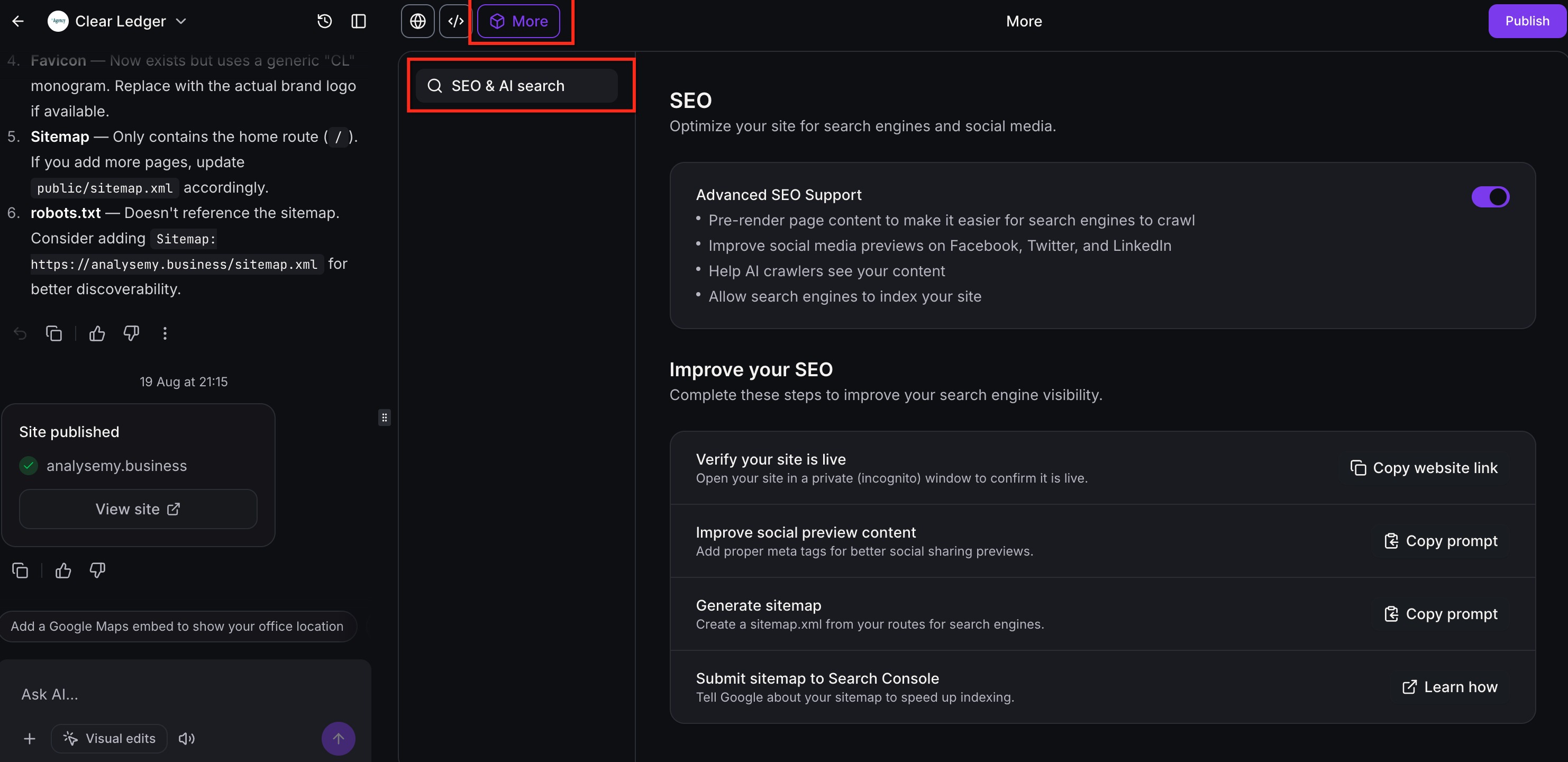
You can also ask in the AI Studio chat: What stack is this project on?
Visitors, search engines, AI crawlers and link-preview bots all receive the same complete page. There is no toggle to turn on, and a custom domain is not required for crawlability. This means:
Crawlers see real content, not an empty JavaScript shell.
Social previews read your title, description and image straight from the page.
AI assistants can read and cite your content.
There is no pre-render cache, route limit or re-publish step to maintain for SEO.
To review the panel:
Open your AI Studio project.
Click More at the top of the builder, then select SEO & AI search.
Confirm the panel shows Pre-rendering is not needed.
Under How your site appears, review the search preview of your title, URL and description.
Server rendering makes your pages readable. It does not write good titles, descriptions or preview images for you; use the Improve your SEO steps below.
Advanced SEO Support pre-renders your pages and serves that HTML to supported bots. Human visitors keep the same fast, interactive experience.
Requirements: the project must be published, and a custom domain must be connected and set as the primary domain. Pre-rendering does not run on the default preview domain.
Open the AI Studio project you want to configure.
Click More at the top of the builder, then open SEO & AI search.
Under Complete these steps to enable, check that Publish your project shows Done. If the domain step is not done, click Go to Domains and finish connecting a custom domain and setting it as primary. See the guide on publishing AI Studio projects and domains.
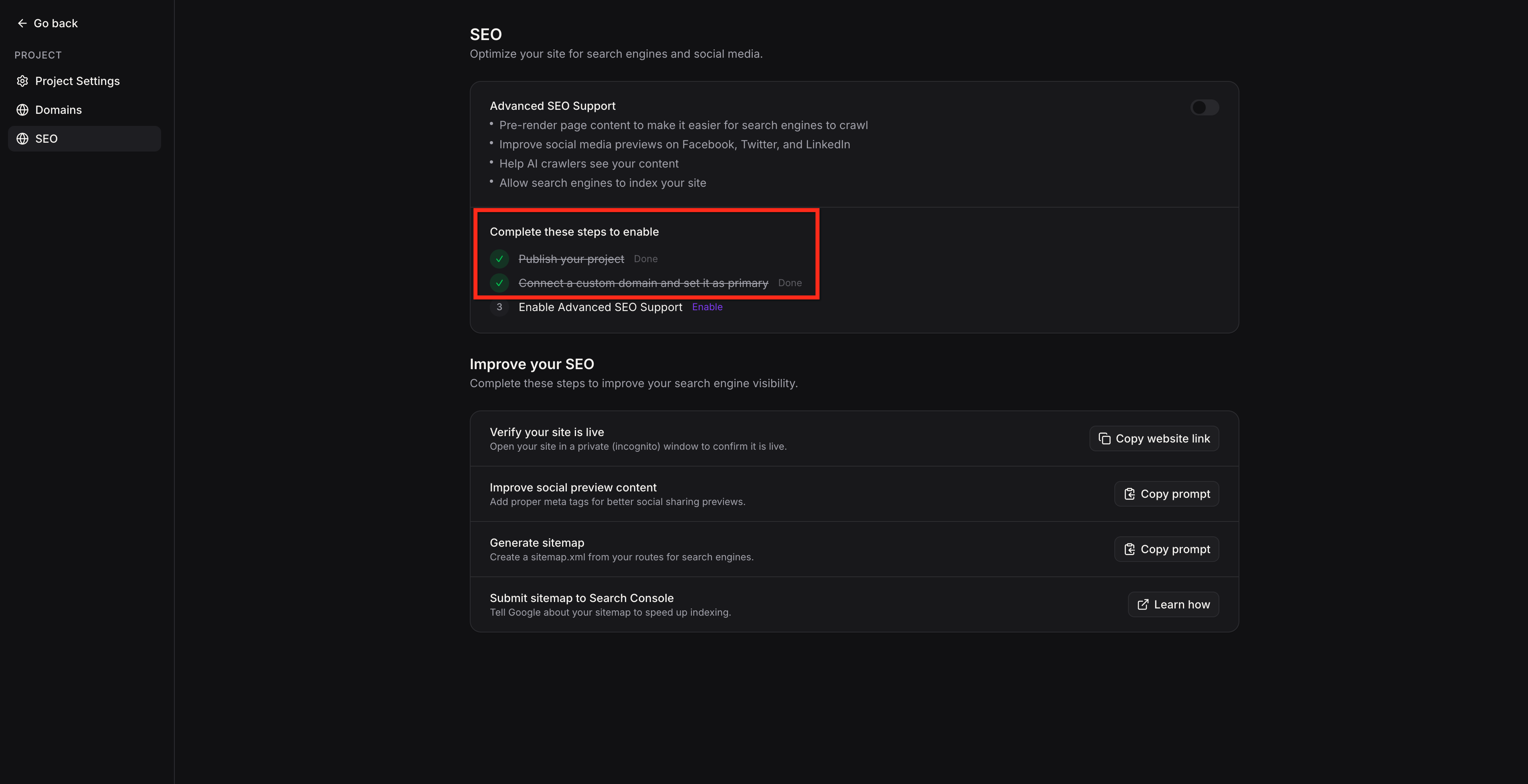
Click Enable to turn on Advanced SEO Support.
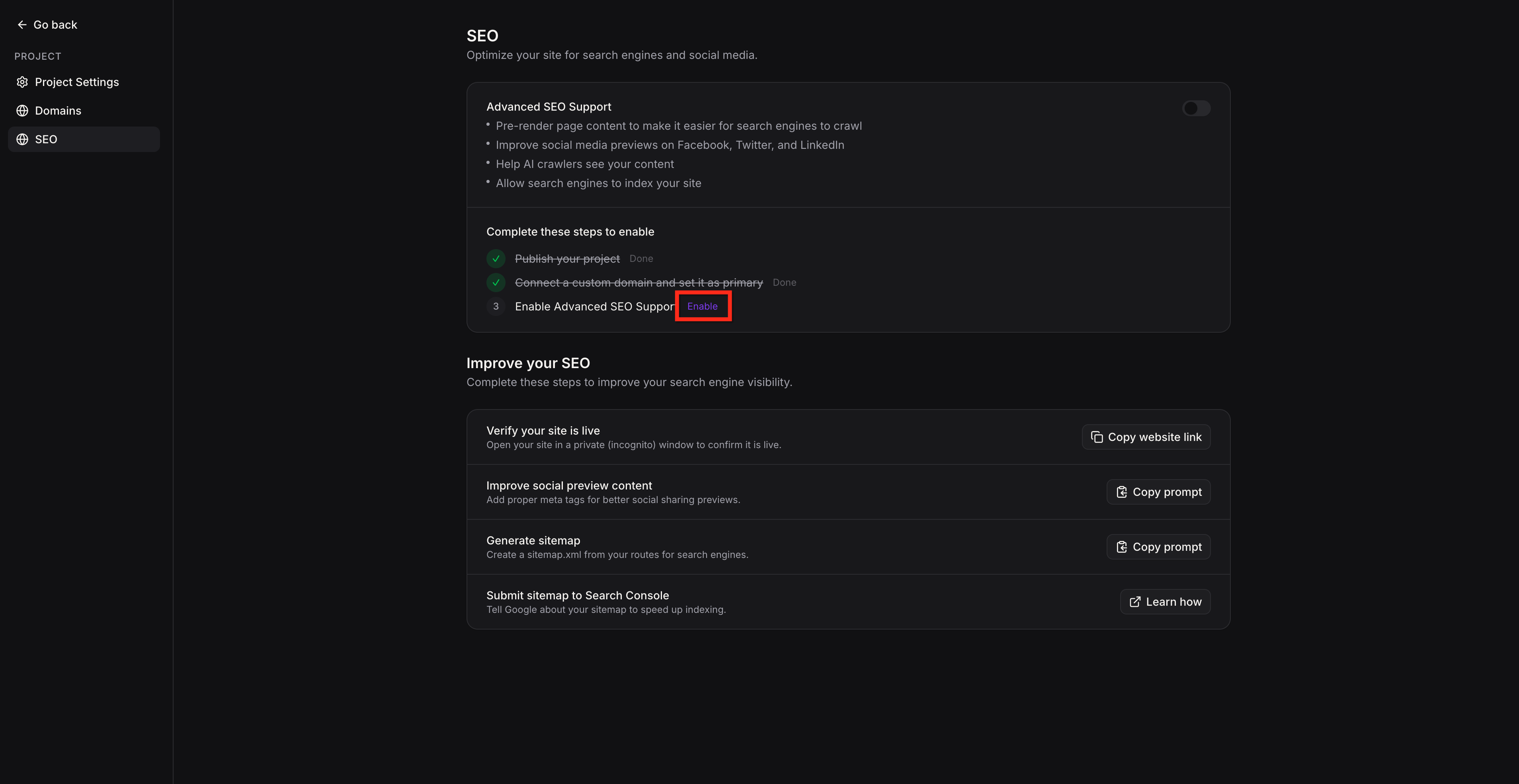
Confirm the toggle turns purple.
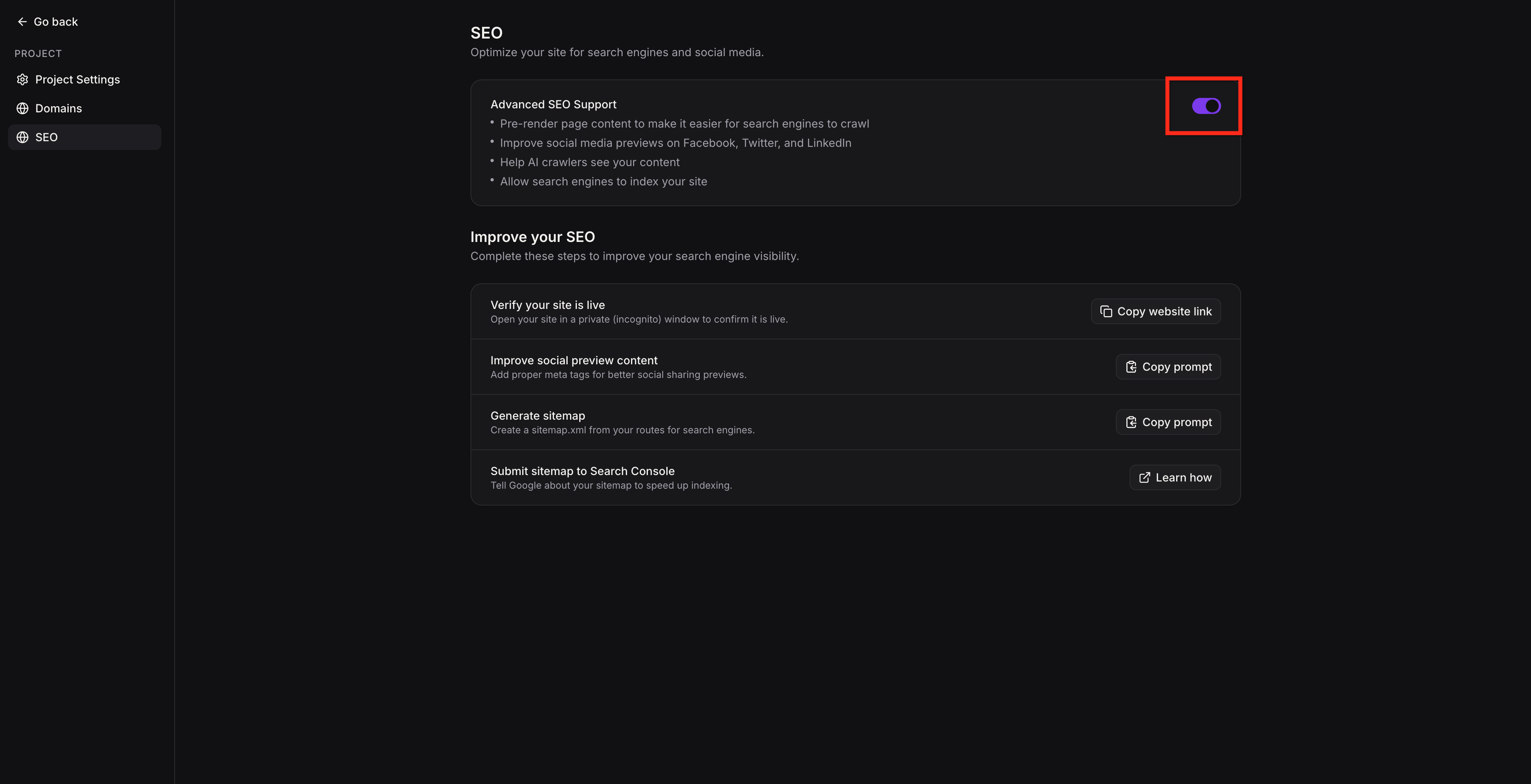
Re-publish the project so the latest rendered output is available to supported bots.
You can turn pre-rendering off for a project at any time with the same toggle.
Automatic bot detection: supported search engine crawlers, social media bots and AI crawlers are served rendered HTML automatically. Other bots get the normal single-page app.
Graceful fallback: if pre-rendering is off or a page is not cached yet, bots receive the standard single-page app, exactly as before.
Automatic cache refresh: pre-rendered pages are regenerated on every publish, domain change or site update. No manual cache clearing is needed.
Route limit: the system handles up to 150 routes (pages) per site.
Edge serving: pre-rendered pages are served from Cloudflare's edge network, so bots get them quickly and visitors are not affected.
What bots can read: page content, metadata, images, canonical tags and structured data that already exist on the page.
Want server rendering instead? You can convert an older project from Project Settings by choosing Migrate to SSR. This creates a separate draft copy; your original project, live site and domains stay unchanged until you publish the copy and move the domain. See the Migrate section of "AI Studio Full-Stack Development: SSR, Server Functions, REST APIs and Secrets".
Readable pages are the foundation. These steps make sure search engines and social platforms show the right information. Both project types have them under Improve your SEO in the SEO & AI search panel; the button names differ slightly.
Step | New projects | Older projects |
|---|---|---|
Edit page titles and descriptions | Ask AI to edit meta details | Improve social preview content, then Copy prompt |
Social link previews | Ask AI to edit meta details | Improve social preview content, then Copy prompt |
Favicon | Ask AI to edit favicon | Ask in the AI Studio chat |
Sitemap | Ask in the AI Studio chat | Generate sitemap, then Copy prompt |
Verify site is live | Copy website link | Copy website link |
Submit sitemap to Google | Learn how | Learn how |
Links shared on Facebook, X (Twitter), LinkedIn, WhatsApp, Slack and Discord can show the correct page title, description and Open Graph image instead of a blank preview. Each page can serve its own title, description and preview image rather than a single site-wide fallback.
Open the AI Studio project you want to update.
Click More at the top of the builder, then open SEO & AI search.
New projects: click Ask AI to edit meta details. Older projects: find Improve social preview content and click Copy prompt.
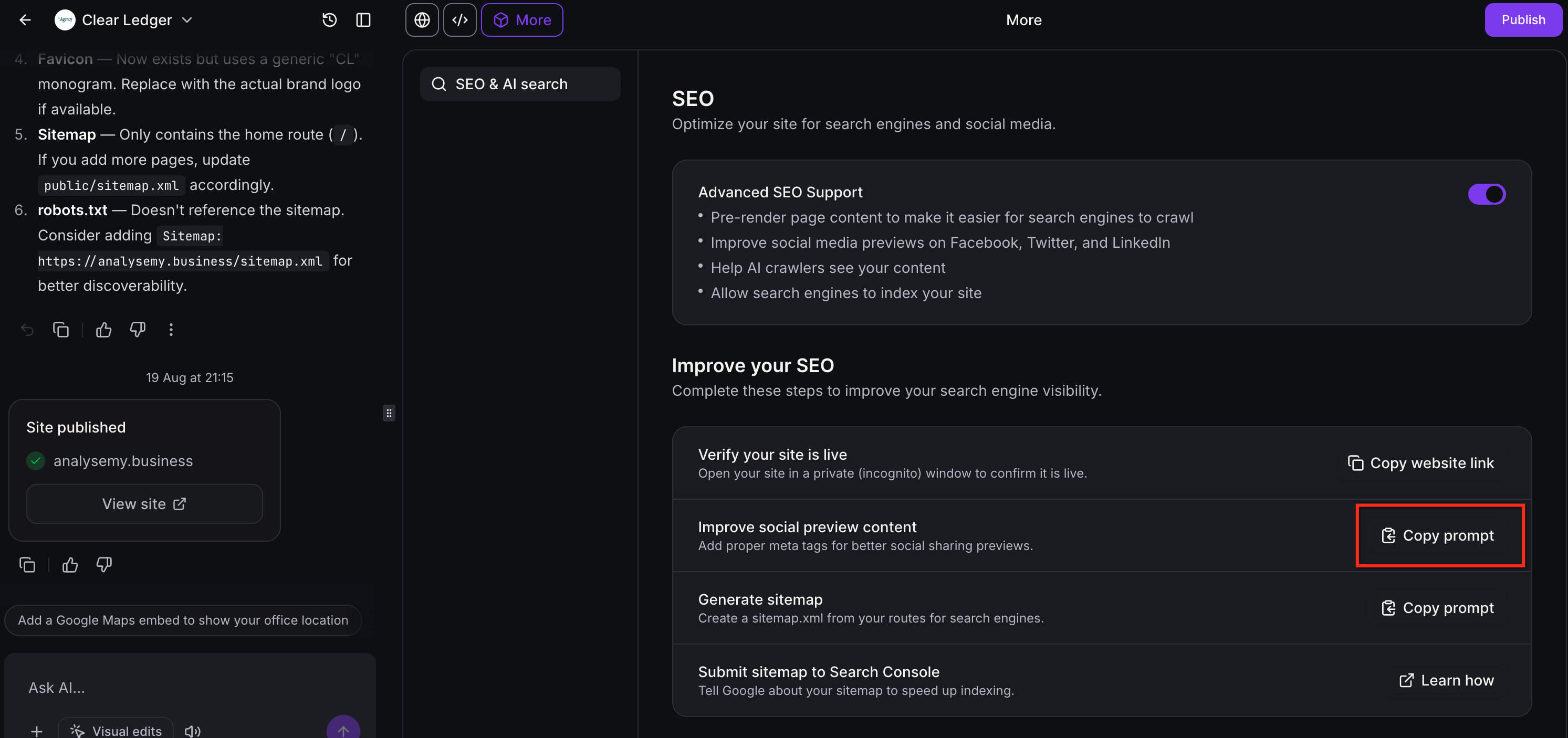
Older projects only: paste the copied prompt into the AI Studio chat.
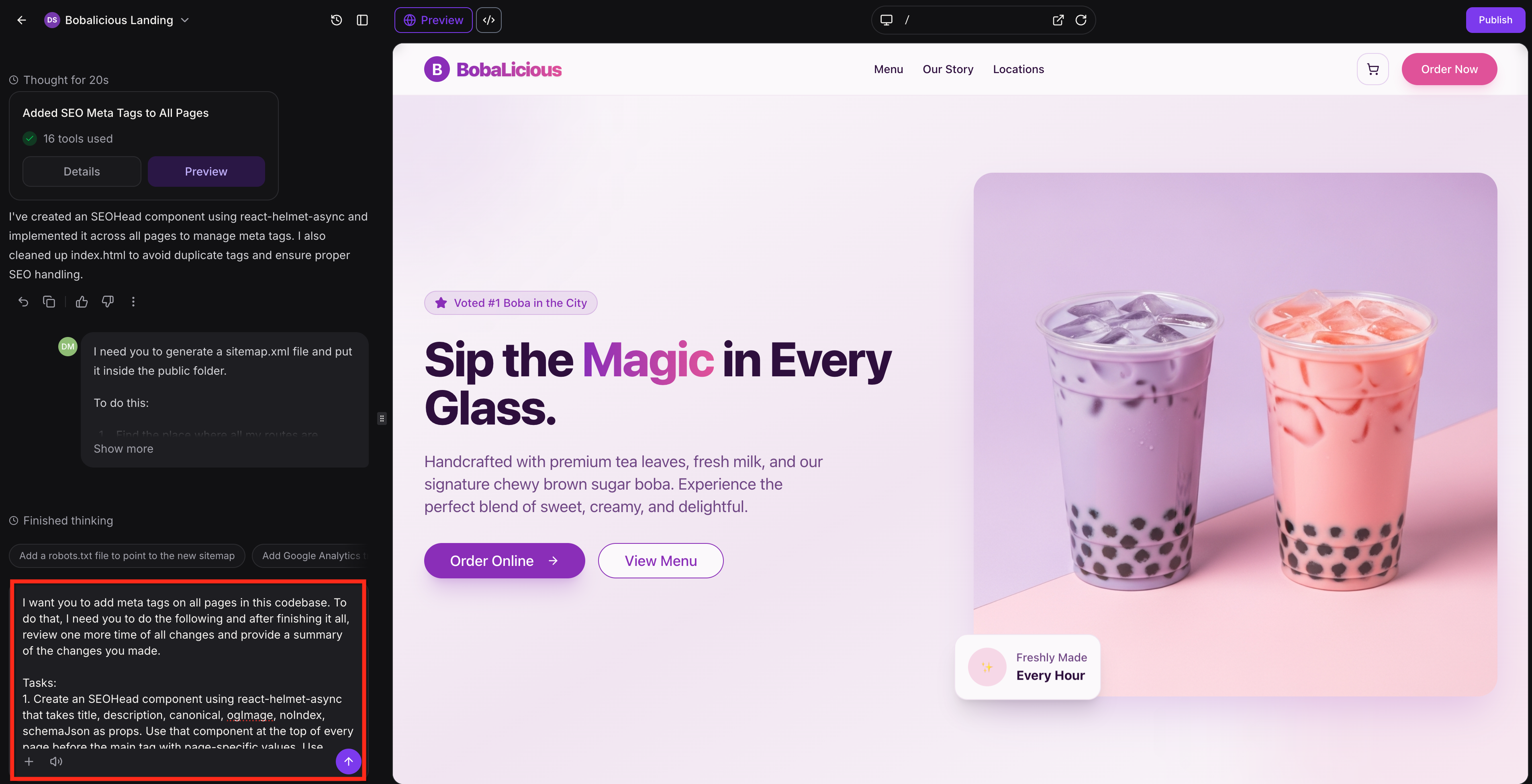
Review the update summary the builder returns, then publish your project to apply the updates.
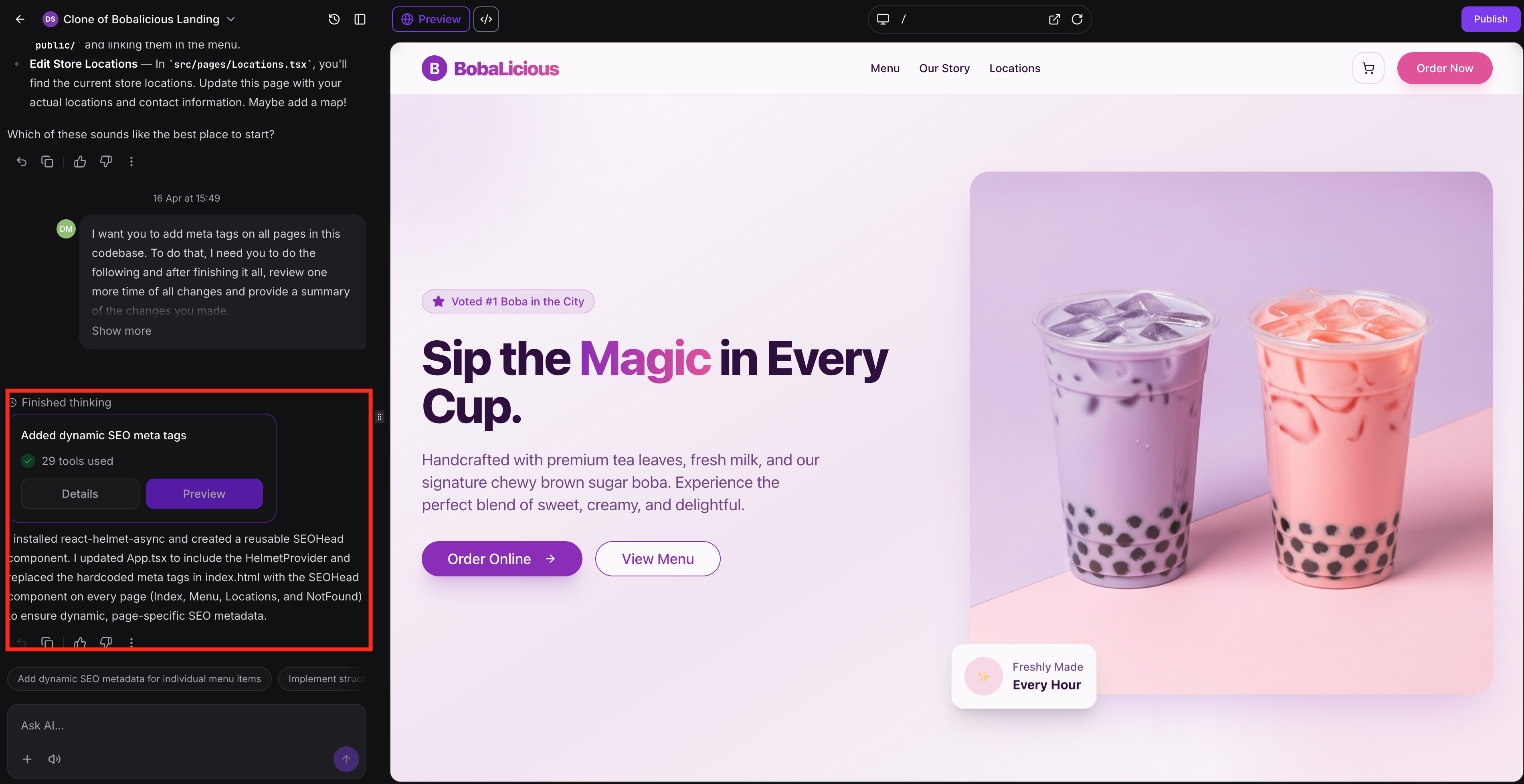
Confirm it works: share the live URL on a supported platform and check the title, description and image. You can also use the Facebook Sharing Debugger, Twitter Card Validator or LinkedIn Post Inspector to confirm Open Graph tags are served and to refresh cached previews.
Tip: use preview images of 1200 x 630 pixels and keep them small (a few hundred KB). Large images may not show in WhatsApp.
Click Ask AI to edit favicon (new projects), or ask in the AI Studio chat: Update my site's favicon to match my logo. Publish to apply.
A sitemap lists your important pages so search engines find them faster.
Open the AI Studio project and click More, then SEO & AI search.
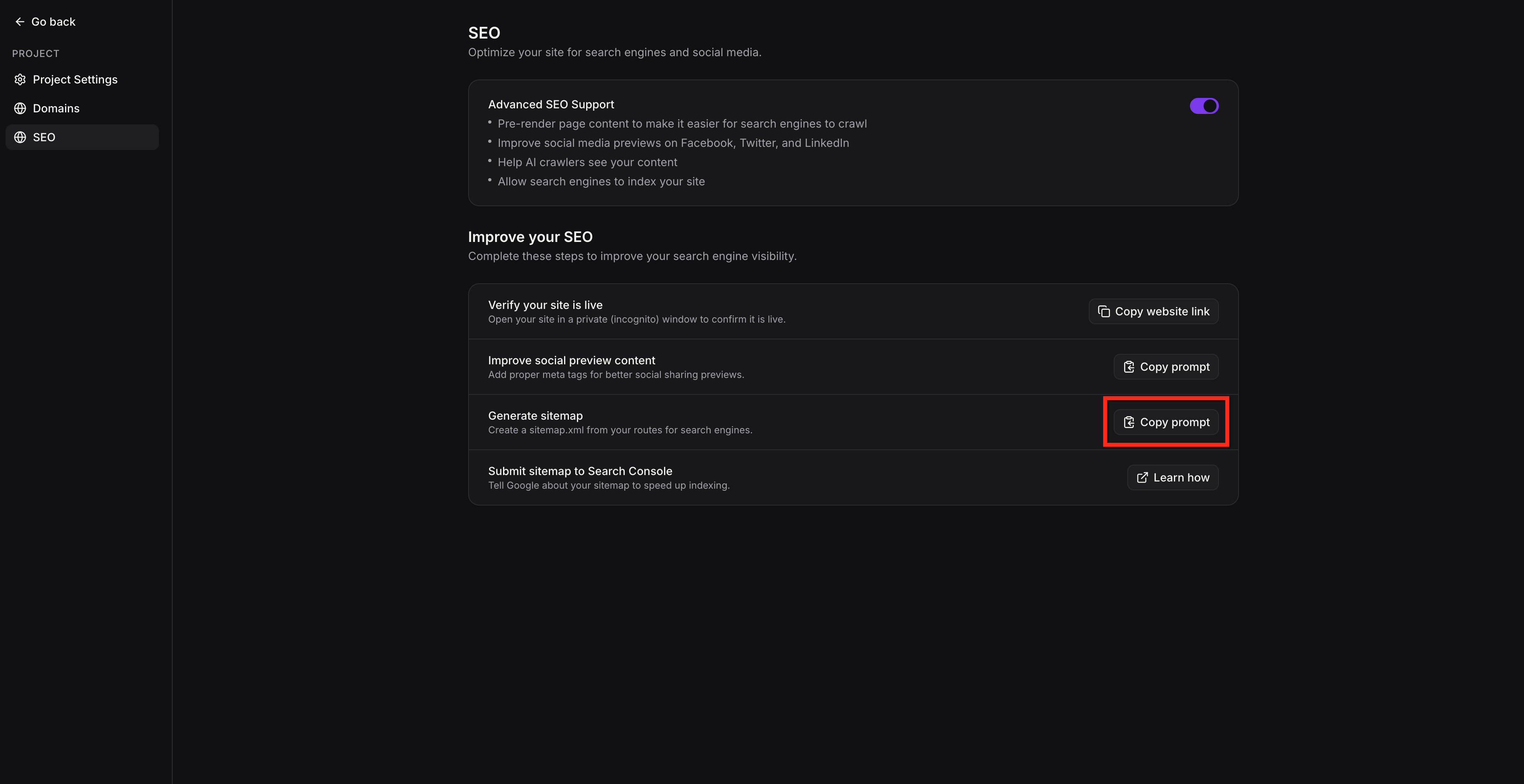
Older projects: find Generate sitemap, click Copy prompt, and paste it into the AI Studio chat. New projects: ask in the chat: Create a sitemap.xml for all public pages.
Review the update summary in the builder, then publish your project. To view the sitemap details, click Details.
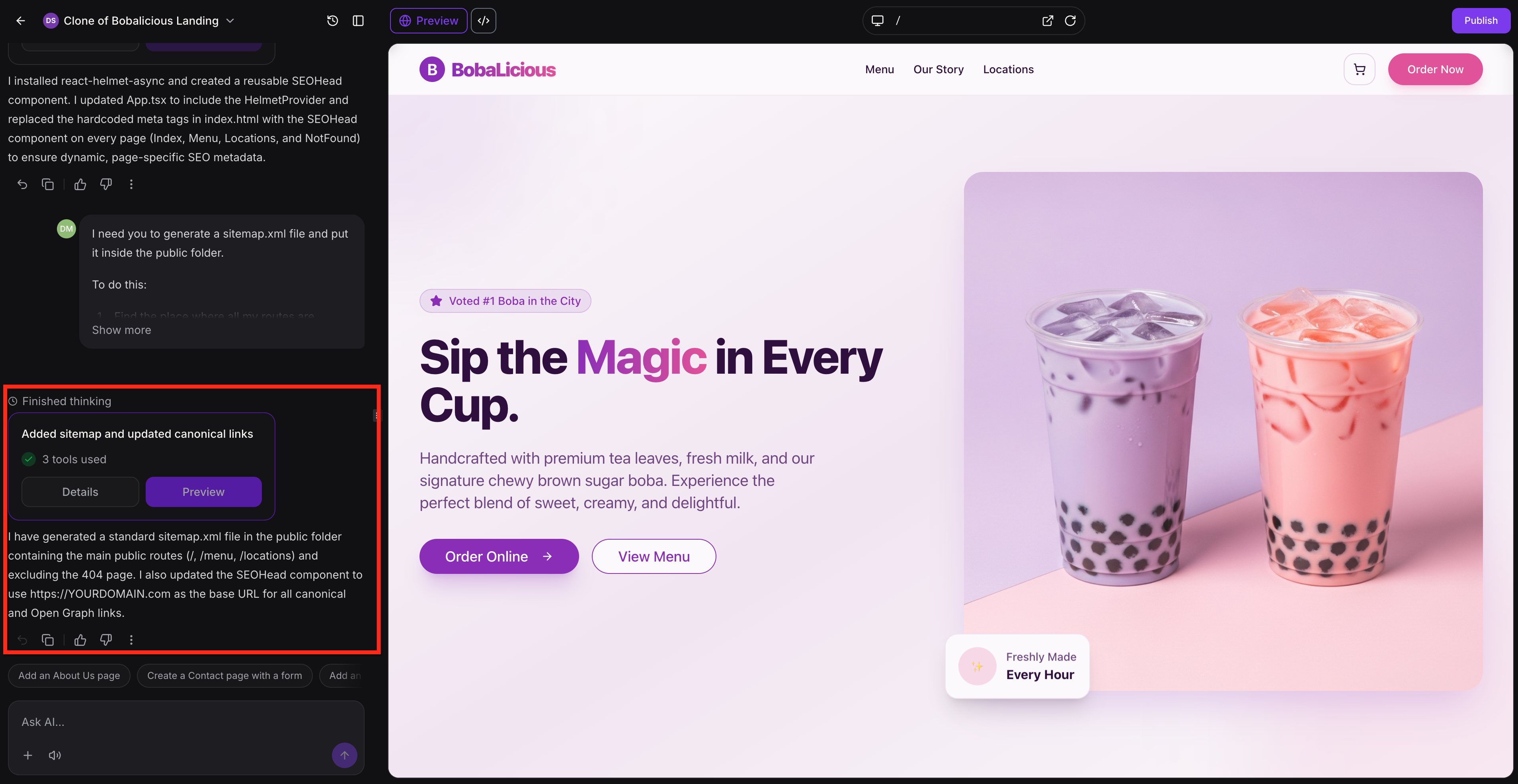
Open yourdomain.com/sitemap.xml to confirm it lists your pages.
Click Copy website link and open it in a private (incognito) window to confirm the site is live.
Add your site to Google Search Console and verify it.
In Search Console, open Sitemaps and submit your sitemap URL. This helps Google discover your pages and lets you monitor sitemap processing.
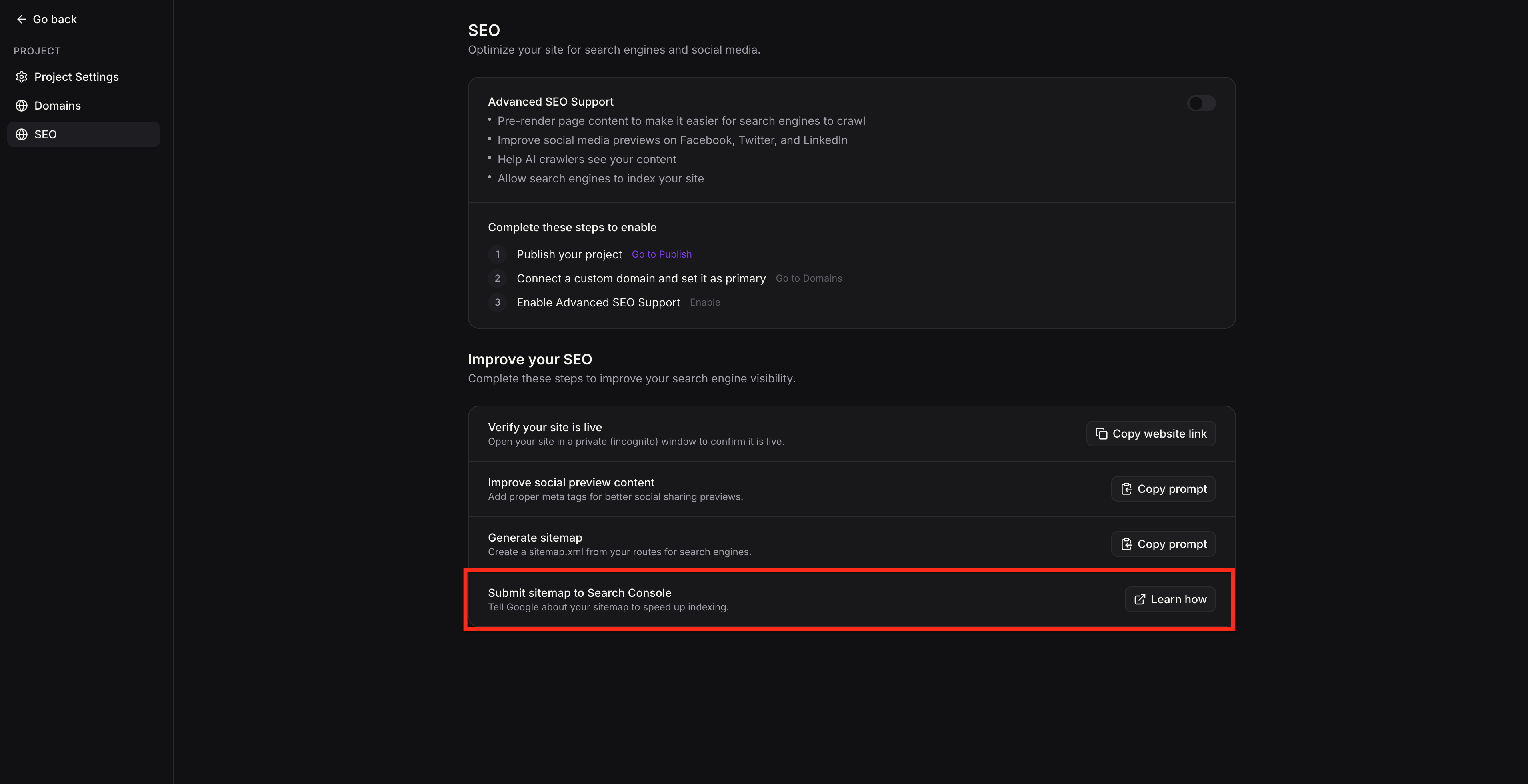
Use URL Inspection, then Request indexing, for your most important pages (for example your top treatment pages).
If you change your custom domain later, verify the new domain in Search Console and submit the sitemap again.
Technical setup gets your pages read. Rankings and AI citations still depend on content, structure and links. You can ask the AI Studio chat to help with each of these.
Content and structure
One clear H1 per page, with headings in order (H1, H2, H3).
Alt text on every meaningful image.
Important facts written as visible text, not only inside images.
Short, direct answers to the questions your patients ask (for example "How long does a laser session take?"). AI assistants cite these.
Metadata
A unique title and description for every important page.
A preview image per page instead of one site-wide image.
Structured data (schema) where it fits, such as LocalBusiness, Event or FAQ. Advanced SEO Support does not add it for you.
Domain and authority
Use a custom domain, set it as primary, and verify it in Google Search Console.
Link to your site from your social profiles, listings and partner sites.
Prompts to try in the AI Studio chat
Review every public page and give each one a unique title and meta description.
Add alt text to all images that are missing it.
Add LocalBusiness structured data using the address and hours on the contact page.
Add an FAQ section to the home page with FAQ structured data.
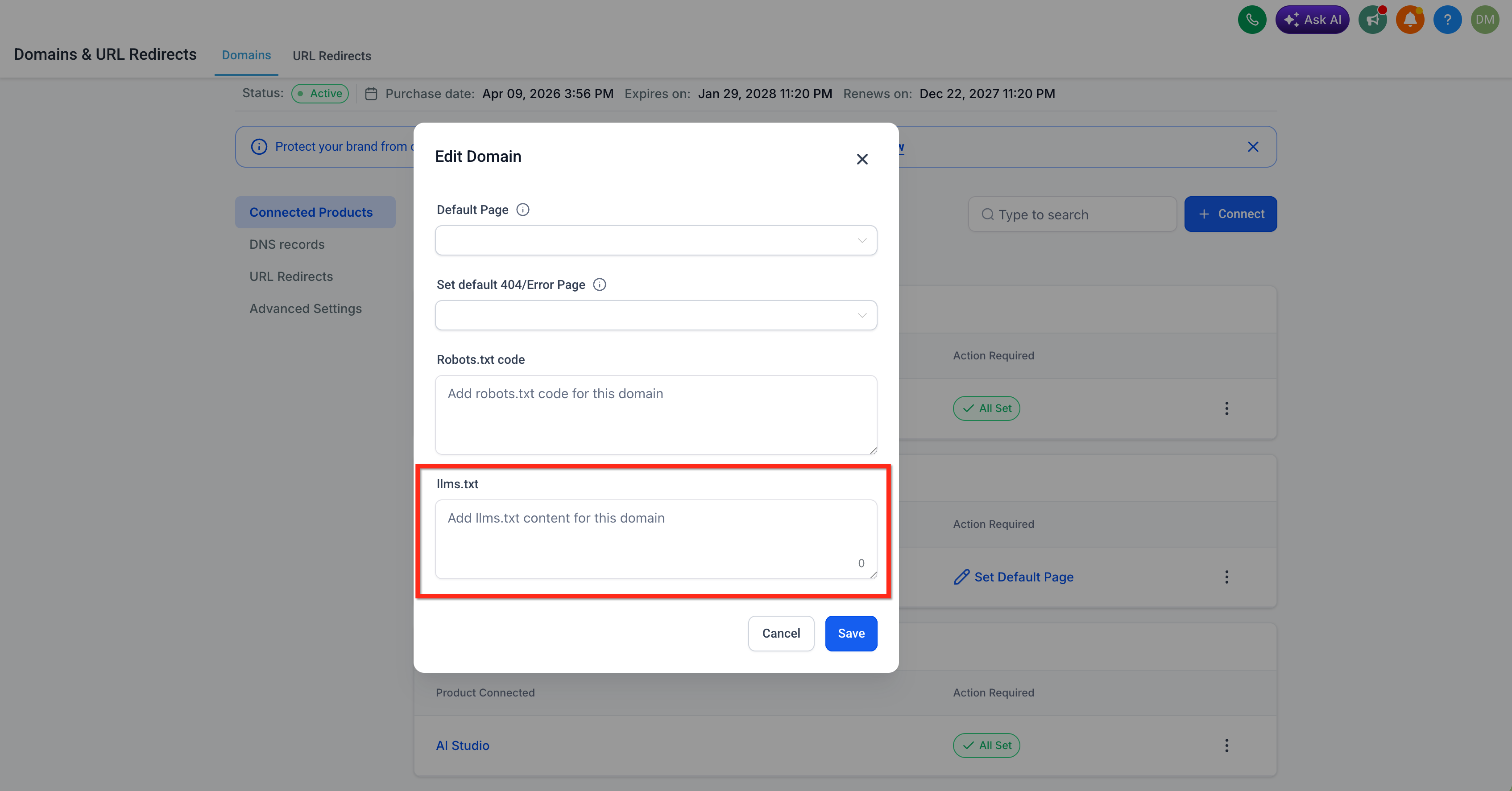
An llms.txt file is a Markdown summary of your site placed at https://yourdomain.com/llms.txt. It works a little like robots.txt but is aimed at AI agents and language models: a plain-text roadmap of your site name, a short summary and a curated list of key pages. It can also help with automated "agentic browsing" checks in Google PageSpeed Insights.
For AI Studio, you do not need to write it by hand: ask the AI Studio chat to generate the llms.txt content for your project. For example: Create an llms.txt file for this site with a summary and links to my main treatment and contact pages. Publish to apply.
A good file uses a single # heading for the site name, a short blockquote summary, and ## sections with described links:
# Example Aesthetics Clinic
> Example Aesthetics Clinic offers injectables, laser treatments and skin care consultations.
## Key Pages
- Treatments: Overview of our primary services.
- Book a Consultation: How to schedule your first visit.
- Contact: Location, hours and contact options.
## Optional
- Blog: Educational articles and clinic news.
Notes:
llms.txt does not replace your XML sitemap. Use both.
It does not guarantee your site appears in AI-generated answers; each AI platform controls its own crawling and ranking.
The file contains only what you put in it. Review it whenever important pages are published, removed or moved.
Websites and funnels connected to a domain have their own llms.txt field under Settings > Domains and URL Redirects: choose Manage on the domain, open the three-dot menu next to the connected product, choose Edit, and paste Markdown into the llms.txt section. AI Studio projects are handled through the chat as described above. Each domain or subdomain needs its own file.
Problem | What to check |
|---|---|
The panel shows Enable but nothing happens | Confirm the project is published and a custom domain is connected and set as primary. Pre-rendering does not run on the default preview domain. |
Bots still see an empty page (older project) | Confirm the toggle is purple, then re-publish. Pages not yet cached fall back to the single-page app. |
Link preview shows the wrong title or image | Give each page its own title, description and preview image, publish, then refresh the platform's cached preview with its debugging tool. |
A page is missing from search | Only published, public pages can be indexed. Check the sitemap lists it, submit the sitemap in Search Console and use Request indexing. |
Site has more than 150 pages (older project) | Pre-rendering covers up to 150 routes. Consider converting to a server-rendered copy, which has no route limit. |
My project says "Pre-rendering is not needed." Do I still need a custom domain?
Not for crawlers to read your pages. A custom domain, set as primary, is still recommended so your search presence, backlinks and Search Console data build on a domain you own.
Do I need to publish before my site shows up in search?
Yes. Only published, public sites can be indexed. Unpublished changes are not visible to search engines.
Does pre-rendering change how my site looks for visitors?
No. On older projects, only supported bots receive the pre-rendered HTML; visitors get the same interactive site. On new projects, everyone gets the same server-rendered page.
Can I move an older project to server rendering?
Yes, but you do not have to. Open Project Settings and select Migrate to SSR. AI Studio creates a separate draft copy and converts it in chat; your original project, live site and domains are not changed. Before publishing the copy, test forms, calendars and integrations, re-add secrets and update any workflow filters that point to the original project.
Why does my link preview still show the wrong title or image?
Check that each page has its own title, description and preview image, then publish. Platforms cache previews, so refresh them with the platform's debugging tool.
How long until Google indexes my site?
Usually days, sometimes longer. Submit your sitemap in Google Search Console and use Request indexing for priority pages to speed it up.
Does Advanced SEO Support add schema markup?
No. Ask the AI Studio chat to add structured data. On older projects, pre-rendering then serves it to bots; on new projects it is already in the server-rendered HTML.
Do I need an llms.txt file for AI search?
It is optional. AI assistants read your rendered pages, so clear headings, visible facts and good metadata matter most. If you want one, ask the AI Studio chat to generate it.
When does the pre-render cache refresh? (older projects) Automatically, whenever you publish, update and re-publish the site, or change the connected domain.
