The Voice AI Public APIs give developers direct, programmatic access to your Voice AI setup in Aesthetix CRM. Instead of relying only on the in-app controls under AI Agents, your team can manage agents and actions, retrieve call logs and transcripts, browse the voice catalog, and connect real-time webhooks to your own workflows. This makes Voice AI easier to automate, scale, and integrate with the rest of your operational tools.
This article is a high-level overview. For authentication, endpoint details, request and response schemas, rate limits, and other technical specifics, always refer to the official API documentation, which is the source of truth as access requirements, environments, and auth details evolve.
Note on PHI: Don't enter protected health information (PHI) into the Voice AI Public APIs. AI features aren't approved for processing PHI — use them for productivity, communication, scheduling, and engagement, not to store or process medical records. See the HIPAA Compliance guide for details.
The Voice AI Public APIs extend Voice AI beyond the user interface by giving developers programmatic access to its core capabilities. This elevates Voice AI from a product feature to an extensible capability you can build directly into your workflows and applications.
Instead of limiting Voice AI to in-app controls, you can:
Manage agents and actions: Create, update, and organize agents and their behaviors via API.
Retrieve call data: Access call logs and transcripts for reporting, quality assurance, or analytics.
Leverage webhooks: Receive real-time call outcomes, transcripts, and summaries in your own systems.
Programmatic access to Voice AI helps teams standardize setup, reduce manual work, and connect call intelligence to the rest of their stack. This is especially valuable for businesses managing multiple agents, custom workflows, or external reporting needs.
Agent management at scale: Create, update, and organize Voice AI agents and their actions without relying only on manual in-app changes.
Data access: Pull call outcomes, transcripts, and metrics for detailed tracking and reporting.
Faster integrations: Connect Voice AI activity with internal tools, third-party apps, and workflow automation more efficiently.
Better call visibility: Retrieve call logs and transcripts for reporting, quality assurance, and analytics use cases.
Real-time workflow potential: Use webhook-based processes to move Voice AI events and outcomes into your own systems.
Extensibility and operational flexibility: Public APIs make Voice AI not just usable, but buildable. You can construct custom workflows around Voice AI instead of being limited to the UI alone.
Managing agents and actions through API access helps teams automate setup, maintain consistency, and support custom Voice AI deployments across locations or workflows. It also creates a cleaner path for teams that want to build their own provisioning or configuration processes.
This aligns with how Voice AI works in the app, where agents can be created and configured with prompts, integrations, assigned numbers, and other settings. For larger-scale deployments, API-based management reduces repetitive setup work and supports more controlled implementation workflows.
Keep the term actions clear. Voice AI Custom Actions are a separate, documented feature that enables real-time webhook integrations during live calls, allowing an agent to interact with external systems mid-conversation. The Public APIs let you manage Voice AI capabilities programmatically, while Custom Actions explain the live-call integration behavior in more detail.
Access to call data helps teams turn conversations into useful records, reports, and automations. This is especially helpful for operations that need post-call visibility, performance tracking, or downstream actions based on what happened during the call.
The Voice AI Public APIs support retrieval of call logs and transcripts, giving you a way to move Voice AI conversation data into reporting systems, QA reviews, or other external workflows. Voice AI also supports transcript-based workflow automation through the Transcript Generated trigger, which shows how transcript data can drive follow-up actions once a call has ended.
For teams building around post-call intelligence, this means Voice AI data can support use cases such as summarization review, internal notifications, CRM enrichment, and operational reporting. Direct technical users to the official API documentation for endpoint-specific implementation details.
Webhook-based workflows help teams respond faster by sending Voice AI outcomes to external systems without waiting for manual review. This makes it easier to connect calling activity to CRMs, internal databases, alerts, or custom applications.
The Voice AI Public APIs support webhook-based integration patterns, so you can receive call-related outcomes, transcripts, and summaries in your own systems. Related webhook behavior also appears elsewhere, including Custom Webhook workflow actions and Voice AI Custom Actions. These are related concepts but not identical: use the Public APIs for the broader integration value, and reach for the relevant workflow or Custom Action features when you need implementation patterns outside the API overview.
This positioning helps you understand that Voice AI can participate in both live-call integrations and post-call automation, depending on the workflow you are building.
The Voice AI API documentation covers Voices, Call Logs, Agents, and Actions. Access requirements, environments, and auth details may evolve, so always refer to the API docs for the latest information.
You can browse the Voice AI catalog using public APIs:
Get Voices: Retrieve a paginated, filterable list of voices. You can filter by language and optionally pass an agentId to return only compatible voices.
Fetch Voice Details: Retrieve detailed metadata for a specific voice, including a preview URL for testing.
For full technical details, refer to the Voice AI API documentation in the Developer Portal.
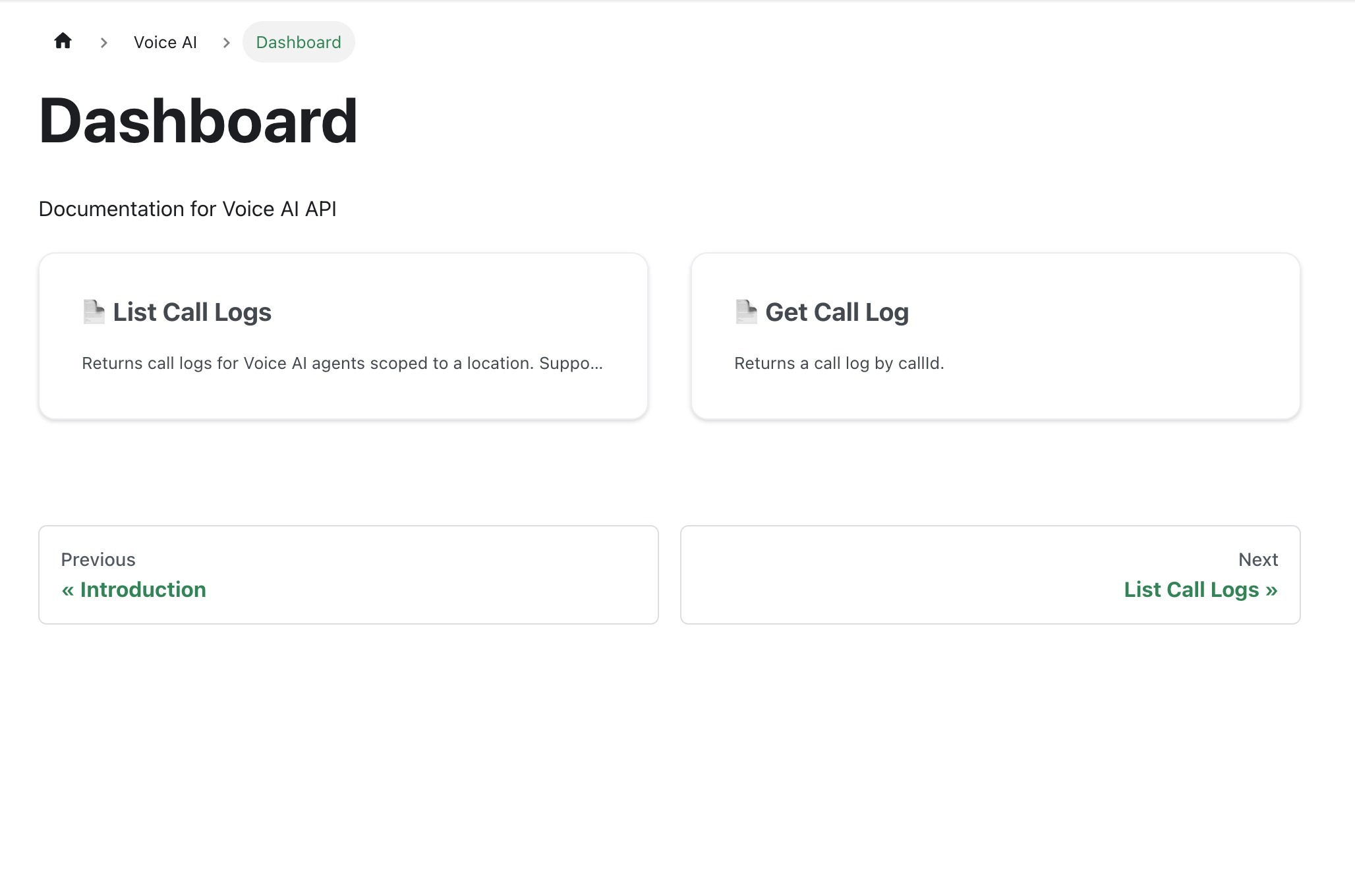
Call Log APIs provide access to calls handled by Voice AI, supporting analytics and quality reviews. Use them to list calls with filters or fetch individual call details, including transcripts when available.
List Call Logs: Returns call logs for Voice AI agents scoped to a location. Supports filtering by agent, contact, call type, action types, and date range (interpreted in the provided IANA timezone). Also supports sorting and 1-based pagination.
Get Call Log: Returns a single call log by call ID.
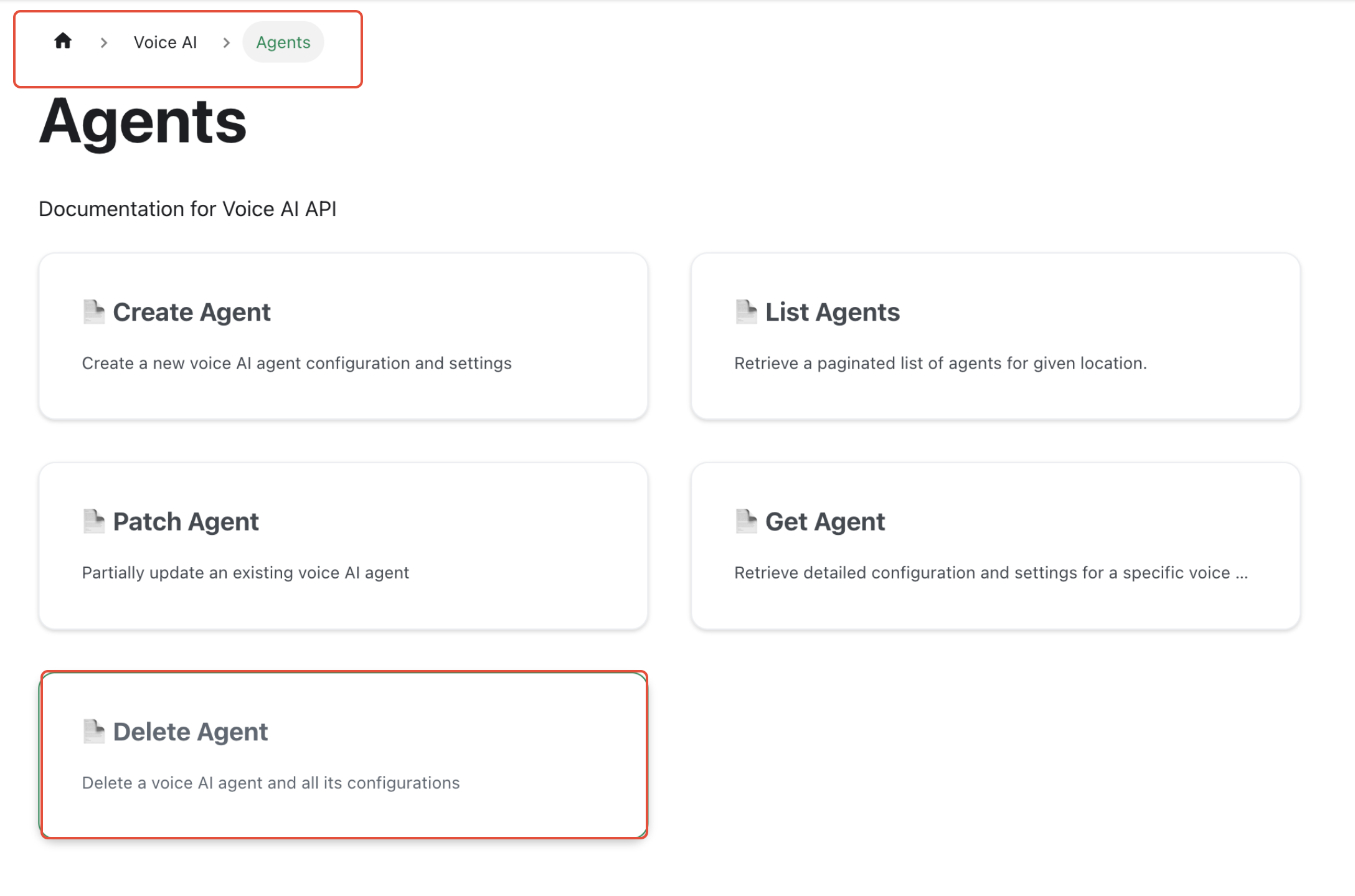
The Agents APIs let you programmatically create, list, read, update, and delete Voice AI agents, so you can roll out consistent configurations across locations and environments.
Create Agent: Create a new Voice AI agent with configuration and settings.
Patch Agent: Partially update an existing Voice AI agent.
List Agents: Retrieve a paginated list of agents for a given location.
Get Agent: Retrieve detailed configuration and settings for a specific Voice AI agent.
Delete Agent: Delete a Voice AI agent and all of its configurations.
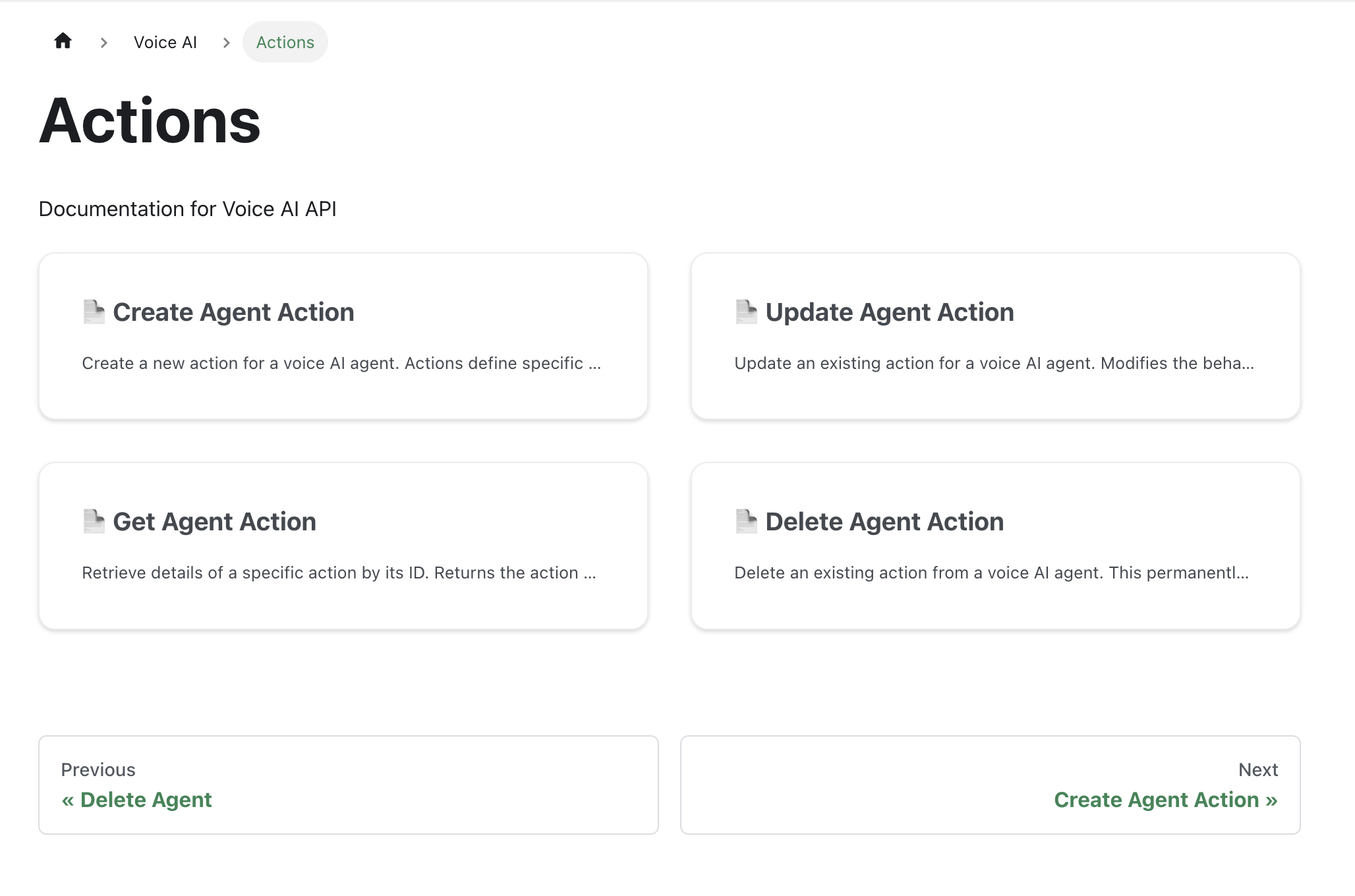
Actions define what an agent can do, such as invoking a webhook, retrieving data, or posting results. The Actions APIs let you create and update these behaviors programmatically and keep them synchronized with your systems.
Create Agent Action: Create a new action for a Voice AI agent. Actions define specific behaviors and capabilities for the agent during calls.
Update Agent Action: Update an existing action for a Voice AI agent. Modifies the behavior and configuration of an agent action.
Get Agent Action: Retrieve details of a specific action by its ID. Returns the action configuration, including actionParameters.
Delete Agent Action: Delete an existing action from a Voice AI agent. This permanently removes the action and its configuration.
Separating live functionality from roadmap items helps set the right expectations, especially when similar Voice AI features already exist under different configuration models.
Today, Aesthetix CRM already supports Knowledge Base Integration for Voice AI Agents, which lets you assign a specific knowledge base to a Voice AI agent so it can return relevant answers based on its configured prompts. That is an existing feature in the current Voice AI experience.
Separately, Knowledge Base Support via the Actions API is planned as a future enhancement and should be treated as an upcoming capability, not a currently released one, unless the official documentation confirms its release.
A proper setup path helps developers move from product understanding to implementation without guessing where to begin. Since endpoint details, authentication methods, and technical requirements live in the developer documentation, the steps below focus on readiness and navigation.
Confirm that Voice AI is already part of your Aesthetix CRM workflow and that your team understands how Voice AI agents are configured in the app. This gives developers the right context before they build around agents, actions, call data, or webhooks.
Review the Voice AI Public APIs capability areas above so you understand what is available today: agent and action management, call data retrieval, voice catalog access, and webhook-based integrations.
Open the Aesthetix CRM API documentation to access the official developer reference for authentication, available endpoints, rate limits, OAuth setup, and implementation guidance.
If you are building a secure internal connection to your own tools, review Private Integrations: Everything you need to know so your team can choose the right integration approach for custom systems and automated workflows.
Map your use case before implementation. For example, decide whether you need to provision agents programmatically, export transcripts for reporting, receive Voice AI outcomes in another system, or support live-call integrations with Custom Actions. This reduces overlap between Voice AI APIs, workflow webhooks, and Custom Actions.
Build and test in a controlled environment, then validate your agent updates, transcript retrieval, or webhook-based workflows before a wider rollout. When needed, use related Voice AI and workflow features to confirm how the UI-based features behave alongside your API implementation.
Q: What can I do with the Voice AI Public APIs today?
You can manage agents and actions, retrieve call logs and transcripts, browse the voice catalog, and connect real-time webhooks to your workflows.
Q: Can I manage voices via API?
Yes. Use the Voices APIs to retrieve available voices and fetch detailed metadata, including preview URLs, to help select the right voice for your agent.
Q: Does this article replace the official API documentation?
No. This article explains what the feature does and how to approach setup. The official API documentation remains the source for authentication, endpoint details, rate limits, and implementation specifics.
Q: Do I need special permissions to use these APIs?
You must have appropriate Aesthetix CRM access to manage Voice AI and read call data. Coordinate with your account admin if you cannot access certain resources.
Q: Is Knowledge Base support through the Actions API already available?
Knowledge Base Support via the Actions API is described as a future capability. The current Knowledge Base Integration for Voice AI Agents is a separate, existing feature.
Q: Are Voice AI Custom Actions the same as the Voice AI Public APIs?
No. Voice AI Custom Actions are real-time webhook integrations during live calls. The Voice AI Public APIs are the broader programmatic access layer for managing Voice AI capabilities and retrieving data.
Q: Can I use Voice AI call data in automations?
Yes. You can use the Transcript Generated workflow trigger for transcript-based automation, and the Public APIs also provide access to call logs and transcripts for external workflows and reporting.
Q: Where should I start if I want to connect Voice AI to my own app or internal tool?
Start with the Aesthetix CRM API documentation, then review Private Integrations if your use case involves a secure internal connection rather than a public Marketplace app.
Q: Where can I find the most current endpoints and request/response schemas?
Always use the official Aesthetix CRM API documentation, which is kept up to date as endpoints and schemas change.
