Marketing consent is the foundation of every message your practice sends. Before you promote a treatment, a membership, or a seasonal special, you are legally responsible for confirming that each patient has agreed to receive marketing communications, and for honoring their request the moment they decide to opt out. This article explains how opt-outs work in your account, how to design an opt-out experience that protects your sender reputation, and the U.S. marketing rules that govern SMS and WhatsApp outreach.
Getting this right is not just about compliance. Clean, consent-based lists deliver better, block less, and keep your phone numbers and WhatsApp sender in good standing so your practice can keep reaching the patients who want to hear from you.
Under the U.S. Telephone Consumer Protection Act (TCPA), you must obtain a patient's express opt-in before sending them any marketing message. This applies to promotional SMS, and to WhatsApp marketing templates where they are permitted. Sending marketing messages to someone who has not agreed to receive them exposes your practice to significant legal and financial risk, and it damages the quality rating of your sending numbers.
At a minimum:
Collect a clear, affirmative opt-in for marketing before that patient's first promotional message. A patient providing their phone number for an appointment is not the same as consenting to marketing.
Keep a record of when and how each patient opted in.
Send only service or transactional messages (appointment confirmations, reminders, results) unless the patient has separately consented to marketing.
Provide a simple, obvious way to opt out in your marketing messages, and honor every opt-out immediately.
Note: Consent for service and transactional messages is treated separately from consent for marketing. A patient can opt out of marketing while continuing to receive essential care communications such as appointment reminders.
An opt-out is a patient's request to stop receiving marketing messages from your practice. When a patient opts out, they should no longer receive promotional outreach from any of your sending numbers, while still receiving the service and transactional messages tied to their care.
Honoring opt-outs is not optional. Beyond the legal requirement, respecting opt-outs is what keeps your outreach healthy:
Lower block rate, lower risk of campaign stoppages. High block rates can lead to campaign suspensions or a decline in your phone number's quality rating. When patients can opt out instead of blocking you, your campaigns run more smoothly.
Faster scaling. As your marketing grows on WhatsApp, quality issues often arise from patients blocking certain templates. Offering an opt-out reduces block rates, which helps you increase your messaging limits sooner.
Respect for patient preferences. An opt-out lets patients choose how they hear from you while preserving your ability to send crucial transactional and customer care messages.
Valuable insight. Unlike a block, an opt-out gives you visibility into patient preferences, so you can refine and improve future campaigns.
You can include a marketing opt-out button in new promotional WhatsApp templates. This button lets patients opt out of marketing messages while still receiving essential service communications. The button is optional, but including it brings real benefits for deliverability and patient trust.
To make the opt-out experience positive rather than punitive, follow these best practices:
Honor all opt-out requests. Once a patient opts out, stop sending marketing messages from all of your WhatsApp numbers. Continuing to message an opted-out patient creates a poor experience and drives up your block rate.
Send a confirmation reply. Acknowledge the opt-out, and offer an easy way to opt back in for anyone who reconsiders. You can also ask why they opted out or what content they would prefer, so you can sharpen your messaging strategy.
Place the opt-out button strategically. Do not add the button to every message, which can encourage unnecessary opt-outs. Instead, include it in high-value moments such as:
The first message a patient receives from your practice.
Messages sent after a long gap with no marketing communication.
Messages targeted at unengaged patients.
By thoughtfully integrating a marketing opt-out button, you improve patient satisfaction, maintain high campaign quality, and gain insight to better tailor your outreach.
Starting April 1, 2025, Meta paused the ability to send WhatsApp marketing template messages to U.S. phone numbers. You can still send utility and authentication templates and reply to patients within the 24-hour customer service window. This change does not affect marketing messages sent to other countries.
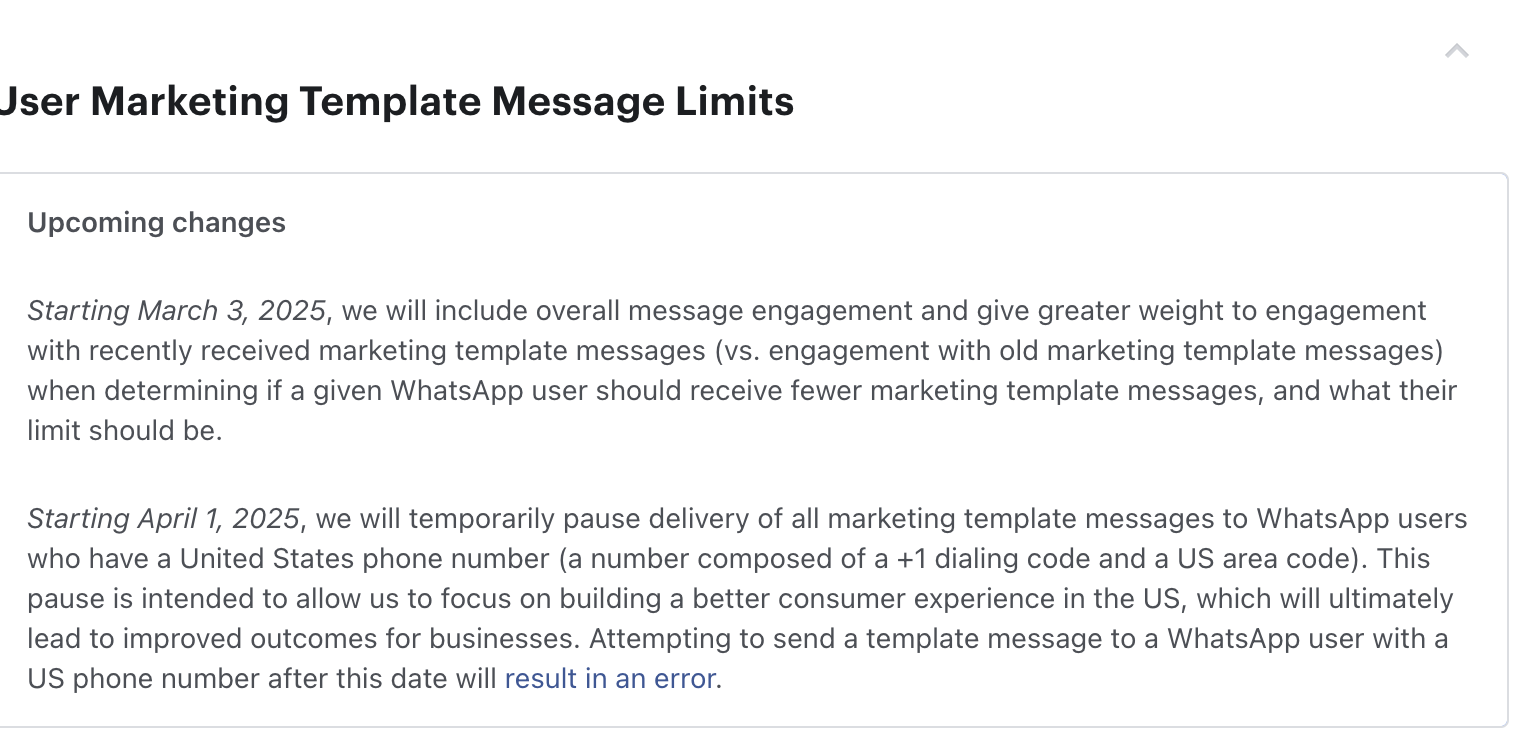
Meta paused U.S. marketing templates as part of a longer-term strategy to optimize WhatsApp's growth. During the pause, marketing messages to U.S. numbers are not delivered, but your practice can still:
Send utility templates for appointment reminders, confirmations, and transactional alerts.
Run Click-to-WhatsApp Ads to engage patients through direct WhatsApp conversations from your ads.
Use the 24-hour customer service window to respond to patient messages in real time.
Utility conversations such as appointment confirmations and transactional alerts.
Authentication messages such as one-time passwords and account verification.
Service conversations (replies within the 24-hour customer service window).
Click-to-WhatsApp Ads to engage patients through targeted campaigns.
To help businesses adapt, an AI-driven WhatsApp Template Migrator is expected to launch. This tool converts marketing templates into utility templates while keeping variables and media intact, which supports:
Continuity in your messaging.
Lower costs by shifting to utility templates.
Higher delivery rates.
To avoid interruptions with your U.S. patients, review and adjust your WhatsApp messaging strategy now:
Review existing marketing templates and transition critical messages to utility templates.
Set up Click-to-WhatsApp Ads for patient engagement.
Maximize real-time responses using the 24-hour service window.
Watch for the release of the WhatsApp Template Migrator.
Note: The pause has no confirmed end date. Meta will reassess based on engagement and performance before re-enabling U.S. marketing templates.
Do I need consent before sending a marketing message? Yes. Under the U.S. TCPA, you must obtain a patient's express opt-in before sending any marketing SMS or WhatsApp marketing message. A patient sharing their number for an appointment does not, by itself, count as marketing consent.
Is an opt-out the same as blocking my number? No. When a patient opts out, they stop receiving your marketing messages but you retain visibility into their preference and can still send essential service messages. A block cuts off all communication and hurts your number's quality rating, giving you no insight in return.
If a patient opts out of marketing, do they stop getting appointment reminders too? No. Marketing consent is separate from service and transactional consent. A patient can opt out of promotions while continuing to receive appointment confirmations, reminders, and other care-related messages.
What is changing with WhatsApp marketing messages in the U.S.? As of April 1, 2025, you can no longer send WhatsApp marketing template messages to U.S. phone numbers. You can still send utility and authentication templates, respond within the 24-hour customer service window, and use Click-to-WhatsApp Ads.
Does the WhatsApp pause affect messages sent to other countries? No. The pause applies only to messages sent to U.S. phone numbers. Marketing messages to other countries continue as usual.
What happens if I try to send a WhatsApp marketing template to a U.S. number now? The marketing template message will not be delivered. Utility and authentication messages will still go through.
How can I keep engaging U.S. patients on WhatsApp? Convert marketing templates into utility templates where possible, use Click-to-WhatsApp Ads to bring patients into direct conversations, and take advantage of the 24-hour customer service window for real-time communication.
When will Meta lift the U.S. WhatsApp marketing pause? There is no confirmed date. Meta will assess engagement and performance before re-enabling U.S. marketing templates.
Where should I place the opt-out button in my WhatsApp templates? Use it strategically rather than on every message. Good moments include the first message a patient receives from you, messages after a long gap in communication, and messages to unengaged patients.
What should I do when a patient opts out? Stop marketing messages from all of your WhatsApp numbers immediately, send a confirmation that acknowledges the opt-out, and offer an easy way to opt back in. Asking for brief feedback can help you improve future campaigns.
