This feature empowers users to connect their physical VoIP deskphones directly to Aesthetix CRM. It provides a stable link between your CRM and your physical phone system, ensuring that all call activities, from making outbound calls to receiving inbound calls, are managed inside Aesthetix CRM. By leveraging this integration, you can enhance call-handling capabilities and maintain a consistent connection to your customer data.
Admins – can provision devices only inside their own location
Other users – read-only; they’ll see a tooltip prompting them to “Ask an admin to configure this.”
Network & protocol prerequisites
SIP over UDP, TCP, or TLS
Open outbound ports 5060/5061 for SIP signalling
Open UDP 10000-20000 for RTP audio
PoE switch or external power adaptor
What to look for when buying hardware
“SIP” and “PoE” on the spec-sheet
At least two programmable line keys
Avoid carrier-locked or proprietary-provisioning devices
Popular models
Yealink T54W / T58W
Poly VVX 450
Grandstream GXP 2170
Snom D785
Cisco 7841
Step 1: Navigate to the Wizard
Log in and go to Settings → Phone Numbers → Advanced Settings → VoIP Deskphone (SIP) → Get Started.
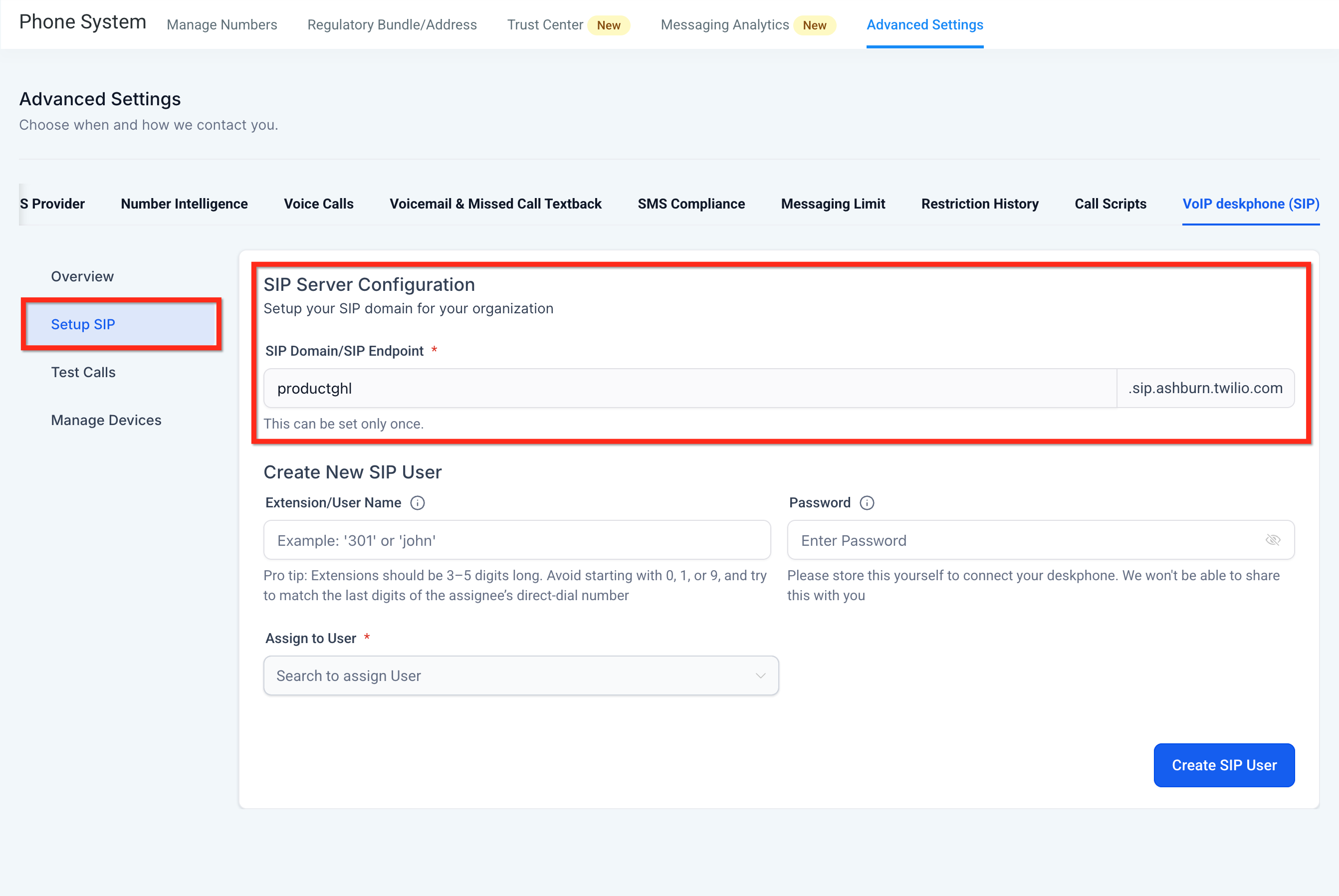
Step 2: SIP Server Configuration
Confirm or edit your SIP domain. A suggested domain such as <LocationName>.sip.ashburn.twilio.com appears.
You can change it once before saving.
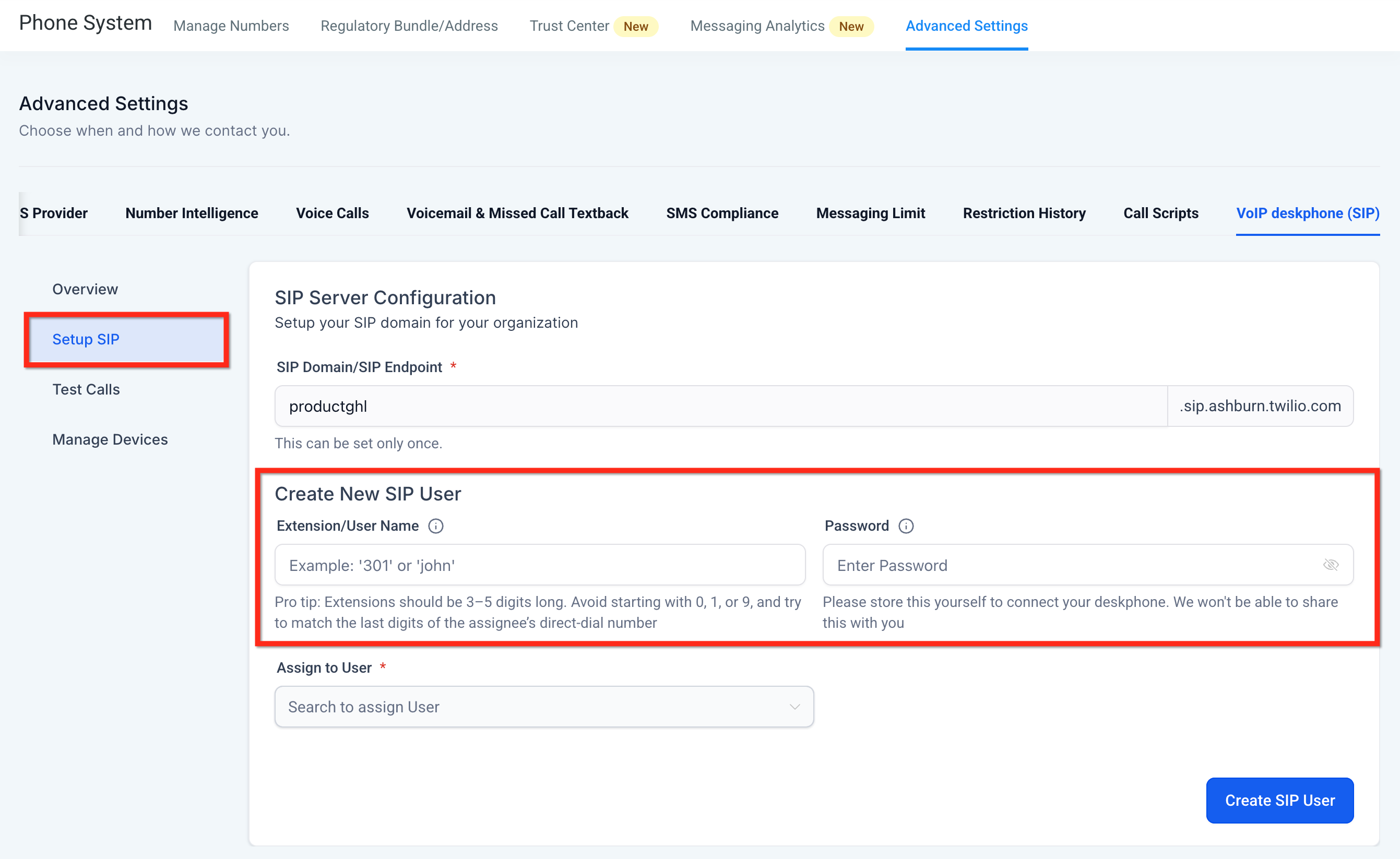
Step 3: SIP User
Choose an extension (number or text) plus a strong password and save them somewhere safe.
For numeric extensions, we recommend 3 to 5 digits that don't start with 0, 1, or 9. Matching the last digits of the user's direct-dial number makes extensions easy to remember. The saved password can't be viewed again later, so if it's lost, reset it from Manage Devices (covered below).
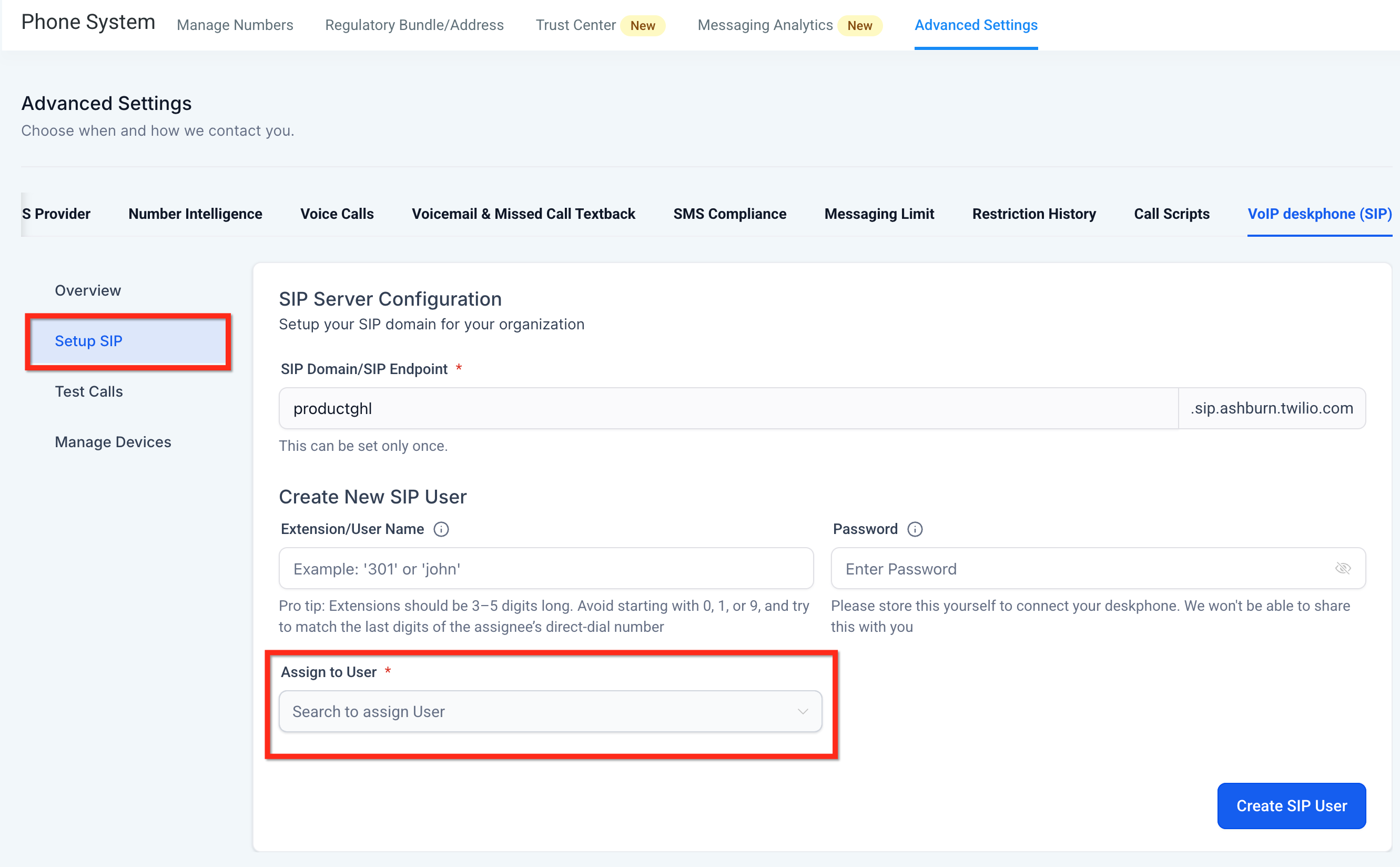
Step 4: Assign User
Each VoIP deskphone needs to be connected to a user in your account. Select one user from the Assign to User dropdown.
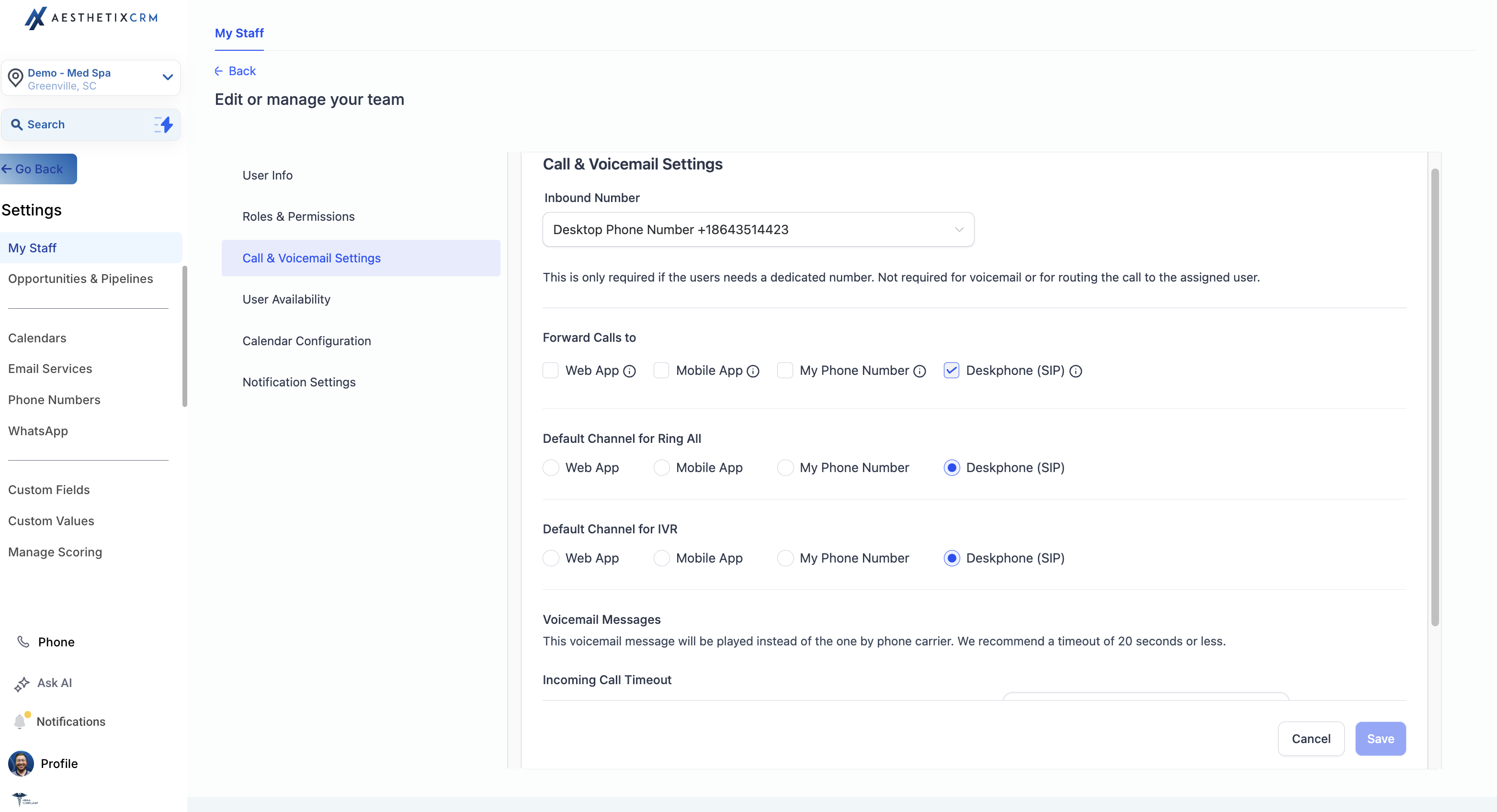
Make sure the user's individual phone settings are configured to use deskphone. Navigate to Settings > My Staff > Choose staff > Edit > Call & Voicemail Settings, please enable "Deskphone" for the options you need. Enable it for "Forward Calls to" to receive calls addressed to you on the Deskphone. If you're receiving calls as part of "Ring multiple", and you want to receive them on the deskphone, enable Deskphone under "Ring all".
If an IVR (phone menu) routes calls to this user, also select Deskphone as the user's Default Channel for IVR so those routed calls ring the deskphone.
Step 5: Configure the Physical Phone
Enter the SIP Domain, Username, and Password into the phone’s Registrar / Server / Proxy fields (varies by phone model and manufacturer).
Note: You should utilize your IT team or MSP to assist you with this process as you have to set this up in your office and re-configure your existing VOIP phones. We recommend you start with your least used desk phone.
If the phone has a Keep Alive setting (often under Account > Advanced), enable it and set the type to Options. This helps inbound calls reach the deskphone reliably.
Before testing, confirm the phone shows the account as Registered (or a similar success indicator).
Step 6: Run the Built-In Test Calls (Optional)
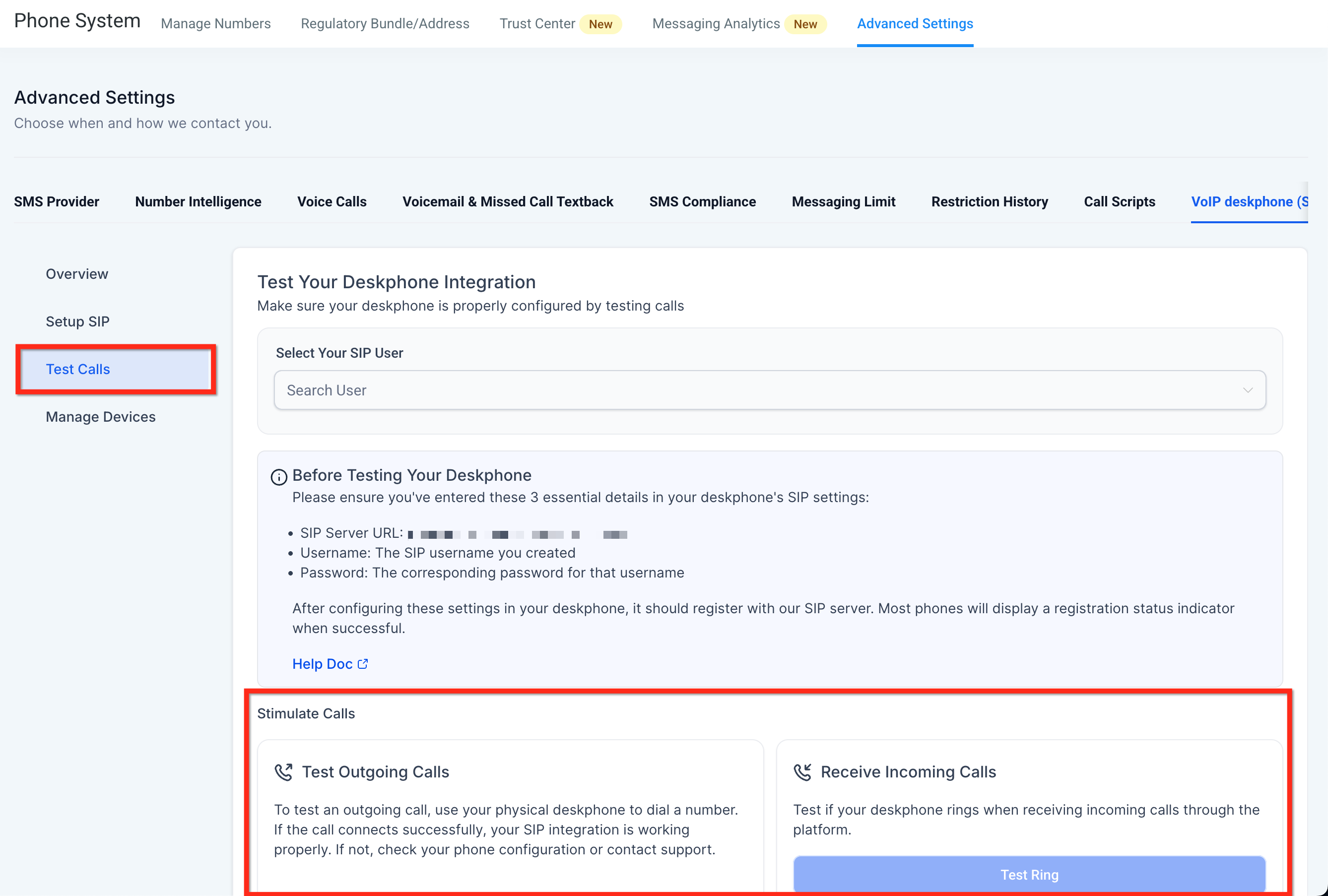
Navigate to VOIP Deskphone (SIP) > Test Calls > Simulate Calls.
Outbound test – Dial the displayed number; you should hear “This is a test call” three times if successful.
Inbound test – Click Inbound Test Call; the deskphone should ring.

Admins can reset a device's password or remove a device from Settings → Phone Numbers → Advanced Settings → VoIP Deskphone (SIP) → Manage Devices.
Reset a device password: Click the pencil icon next to the SIP user, enter a new password, and save. Then enter the same new password on the physical phone. Until the phone is updated, it will fail to register.
Delete a device: Click the trash can icon next to the SIP user. This immediately removes the device's credentials, and the phone can no longer register with that SIP user.
Call another deskphone by extension: Dial the other deskphone's extension directly. For example, if a teammate's extension is 201, dial 201. No outside number is needed, but both deskphones must be set up and registered.
Transfer a call to another deskphone: During a call, start the transfer on your handset, dial the teammate's extension, and complete the transfer on the phone.
Note: Deskphones support blind transfers only (the call is sent straight to the other extension). Warm transfers, where you speak with your teammate before handing off the call, are not currently supported from a deskphone.
Symptom | Likely Cause | Fix |
|---|---|---|
401 / 403 Unauthorized | Wrong username or password (case-sensitive) | Re-enter credentials |
No audio | Firewall blocking RTP (UDP 10000-20000) | Open ports / disable SIP ALG |
Phone rings but won’t answer | NAT / SIP ALG interfering with RTP | Disable SIP ALG on router |
Can’t save SIP domain | Name already taken | Edit the domain or accept the suggested increment |
Phone doesn't register | SIP server, credentials, or network | Check the SIP Domain, username, password, outbound ports 5060/5061, and SIP ALG |
Outbound works, inbound doesn't ring | User routing, Keep Alive, or SIP ALG | See the inbound steps below |
Test ring works, but real inbound calls don't | Phone number call routing | Check the number's routing, assigned users, IVR or Voice AI, Ring all, and the user's Deskphone settings |
Phone stopped registering after a password reset | Old password still on the phone | Enter the new SIP password on the handset |
Still stuck? | – | Click Contact Support with your SIP Domain & handset model |
Confirm the phone is registered. If it isn't, recheck the SIP Domain, username, and password before anything else.
Verify the server and credentials exactly. Use the SIP Domain from Aesthetix CRM as the phone's Registrar or SIP Server, and the exact SIP username and password you created.
Check outbound SIP ports. Your network must allow outbound traffic on ports 5060/5061.
Check the audio port range. Allow UDP 10000-20000. If calls connect but audio is missing or one-way, review this range and SIP ALG.
Disable SIP ALG on your router or firewall if it is changing SIP traffic.
Run the built-in outbound test from VoIP Deskphone (SIP) → Test Calls.
If you see 401 or 403 errors, the username or password on the phone doesn't match what's saved in Aesthetix CRM.
Don't open SIP ports to the public internet or add inbound port-forwarding rules just because calls are failing. Work through the steps above first.
Run the inbound test ring from VoIP Deskphone (SIP) → Test Calls.
If the test ring fails, confirm the phone is still registered and the SIP credentials are correct.
Confirm the device is assigned to the right user in Setup SIP or Manage Devices.
Check the user's Call & Voicemail Settings. Go to Settings → My Staff → Edit → Call & Voicemail Settings and enable Deskphone under "Forward Calls to."
Check Ring all and IVR. If calls reach the user through Ring all or an IVR, select Deskphone as the user's default channel for each.
Review the phone number's call routing. Make sure the user is part of the number's call flow and that an IVR or Voice AI isn't answering the call first.
Enable Keep Alive on the handset with the type set to Options.
Disable SIP ALG if the problem continues.
Retest with the test ring and a real inbound call. If the test ring works but real calls don't reach the phone, the issue is the number's call routing, not the handset.
SIP Domain
SIP extension or username (never send the password)
The user the device is assigned to
Phone manufacturer, model, and firmware version
Registration status shown on the phone
Results of the outbound test and the inbound test ring
Date, time, and time zone of a failed call
The calling number and the Aesthetix CRM number that was called
Any error codes shown
Screenshots of the user's call routing settings
Whether SIP ALG is enabled on your network
Q: Which VoIP deskphones are compatible?
Most open-SIP models—see the recommended list above.
Q: Can I record every call?
Yes. Once enabled, all calls are automatically recorded.
Q: How do I perform a blind transfer during a call? Use the Blind Transfer option on your deskphone UI. Warm transfers are not currently supported from a deskphone.
Q: Is there an extra charge for using deskphones?
No. Deskphone calls share the same per-minute rates as web/mobile calls.
Q: Can two deskphones point at the same Aesthetix CRM user?
No, you can only connect a single user to each VoIP deskphone.
Q: Do you support SIP Trunking?
No, we do not support SIP Trunking as of now. So you cannot connect your existing PBX/Asterix to Aesthetix CRM as of now.
Q: Why am I not able to receive the incoming call on my deskphone?
Make sure the user's individual phone settings are deskphone. Navigate to Settings > My Staff > Choose staff > Edit > Call & Voicemail Settings, please enable "Deskphone" for the options you need.
Q: Can I call a teammate's deskphone without dialing an outside number?
Yes. Dial their extension directly. Both deskphones must be set up and registered.
Q: I reset a device password and now the phone won't register. Why?
The physical phone still has the old password. Enter the new SIP password on the handset.
Q: Does the voicemail button on my deskphone open Aesthetix CRM voicemail?
No. The handset's own voicemail feature is separate. Review voicemails and call activity inside Aesthetix CRM.
